

Saturday, August 6, 2016
Counters
We have game counters for Divine Right. All of them, in high resolution, as it happens. Onward and upward! The artists are really doing a great job and making real progress on this project.

Thursday, August 4, 2016
Divine Right title screen
The art continues to come along well. The map is done, the counters are done too, and now it's time to start on the UI and other game elements such as information screens and effects.

The title screen portrays an army, presumably one belonging to Immer or Hothior, riding towards the Temple of Kings.

The title screen portrays an army, presumably one belonging to Immer or Hothior, riding towards the Temple of Kings.
Tuesday, August 2, 2016
38 Studios: no charges filed
This must come as a relief to the concerned parties:
The fallout from 38 Studios’ drastic shutdown in 2012 continues to play out, as Rhode Island Attorney General Peter Kilman and State Police Colonel Steven O’Donnell announced in a press conference today that no charges would be filed against government officials or former 38 Studios employees after a 4-year investigation.I always felt vaguely bad about the catastrophe that was 38 Studios. Not that it was even remotely my fault or that I had anything to do with it, but I was casually acquainted with its founder, Curt Schilling, through both of us being players of Advanced Squad Leader and subscribers to the ASLML, and when I heard he was founding a game dev studio, I got in touch and told him that I'd be happy to talk to him and answer any questions he might have about the various pitfalls that awaited the unwary developer. He was appreciative, but assured me that he had a top-notch team around him, so I wished him well and promptly ceased to give the matter any further thought. Seeing how things eventually turned out, I rather wish I'd been a bit more pushy.
According to local news station WPRI, the two stated that no criminal activity had been found in the arrangement of a $75 million loan for the production of an MMORPG called Copernicus that was backed by Rhode Island taxpayers. Civil investigations by the State and the SEC are still ongoing, and an 8-page report from the Attorney General’s office states that charges could be brought if new information is brought to light.
However right now, “the quantity and quality of the evidence of any criminal activity fell short of what would be necessary to prove any allegation beyond a reasonable doubt and as such the Rules of Professional Conduct precluded even offering a criminal charge for grand jury consideration,” the report states.
The downfall of 38 Studios was a calamitous event for both the people of Rhode Island and the 200+ developers of 38 Studios and Big Huge Games, who were working on Kingdoms of Amalur: Reckoning and Copernicus. The undying legal action in this case highlights how game developers can become embroiled in local political conflicts when the risks of game financing clash with taxpayer money.
Friday, July 29, 2016
Map Draft complete

The first complete draft of the map of Minaria is complete. If you notice any mistakes, this would be an excellent time to mention them.
Tuesday, July 19, 2016
Selling It
For Elveteka, I wrote music for an elfish fortress defiled by orcs.
 |
| Artwork by Santiago Iborra |
There is craft in the piano reduction: the counterpoint works, there is a gradual rising and falling line that delineates registral space, a balanced melody, a sense of structure coming from the time signature change in the second half, a shifting of which voice carries the melody, appropriate sonorities, and so on.

It's easy to teach pitch and rhythm, but if that's all you know, you've been robbed. Music needs to capture your imagination. Ask, would you buy this?
Of course not! It sounds just like any other piano reduction.
We need color. The basic idea is an almost regal fanfare beset by eerie harmonies. Here's an early draft of the composition that I submitted to my team.
It's not bad, but did I sell it? I would say no. It sounds too polite, too nice. I needed more light coming through the windows and a sense of dark power underneath. Let me add some sustained strings in the upper register to represent the light, and a dark synth in the bass to represent the foreboding power. While I'm at it, I'll make sure the staccato strings are crisper and more defined - more aristocratic, if you will. I'll even add in a chromatic, arabesque harp line in the second half to signify a sort of dark aristocracy. Here you go:
The feeling is there. Time for a reality check. Did I evoke a world? Did I really do it? Prince, master of intangibles, says naw.
Whose fantasy is more vivid? Whose frame is stronger? Who better evokes aristocracy?
Prince, of course. Always trust the greats.
Sunday, July 17, 2016
The importance of communication
No matter how hard we try, important details are often lost in translation from one dev team member to another. This is why it is often important to go back and confirm that what we think we told the other person is exactly what they not only heard, but understood.
Case in point: I told the lead artist, whose first task is recreating the 1979 Divine Right map, that we were going to be using the standard 4k resolution of 3840x2160. This will, to a certain extent, future-proof the game, and allow for a very nice wargaming experience for those with big, high-resolution screens. What I meant is that 3840x2160 would be the base resolution for the game art; anytime a game is being developed, everyone has to know what the base graphic standard is, whether it is MCGA (320x200, 256 colors) to 4k (3840x2160, 16.7 million colors).
 However, what the artist heard is that the map should be 3840x2160. In order to fit those parameters, he had to horizontally squash the hexagons, which produced the compressed effect that can be seen to the right.
That's not his fault, as I knew that he is a DevGame attendee and therefore should have remembered that he does not yet speak the same dev language that a more experienced game developer does. We were talking about a map, a map is defined by a specific resolution, and a specific resolution was selected. It was perfectly sensible for him to create the map at the resolution specified, and he did a very nice job of it. The fault, the responsibility for the error, was all mine.
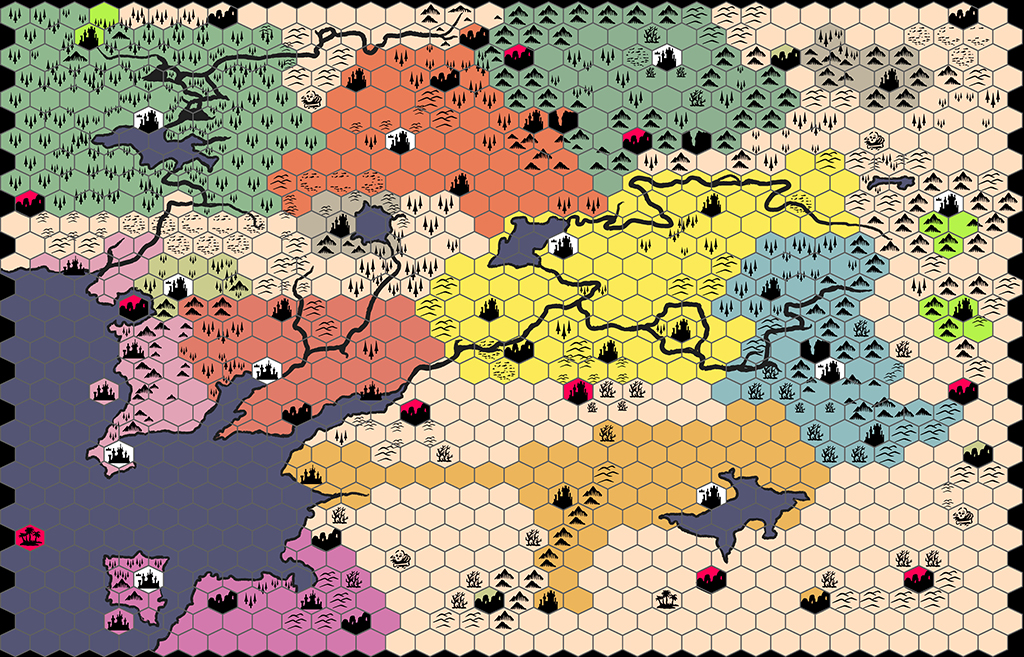
Fortunately, one of the things we also teach in DevGame is the concept that one should never be afraid of making mistakes or correcting them, but rather address them as quickly as possible. Even more important is to prepare for the eventuality that a mistake will need to be corrected, so always work in a way that allows for maximum future flexibility. The artist did that by choosing to create the basic map in vector graphics, which meant that it could be easily resized; it was literally a matter of minutes before he sent over the revised map below, the hexagons no longer compressed.
 The number of hexes is still the same, the height is still equal to the vertical resolution,, but the width no longer fills the horizontal resolution, which will leave space for monarch personality cards and other UI elements. The text needs to be redone, but that is a relatively minor task; the important thing is that nothing needed to be redrawn. This is a good example of a problem caused by a communication error that is promptly fixed by smart development processes combined with continuous communications.
Frequent and open communication is the key to quickly identifying and correcting problems. Don't ever allow yourself to avoid communicating or go dark for fear that you're doing, or have done, something wrong; that is the best way to ensure that whatever issues you've got are going to get worse and become serious problems. If you're not sure something is right, if you're starting to suspect something might be wrong, don't hesitate to look into it and talk about it.
Case in point: I told the lead artist, whose first task is recreating the 1979 Divine Right map, that we were going to be using the standard 4k resolution of 3840x2160. This will, to a certain extent, future-proof the game, and allow for a very nice wargaming experience for those with big, high-resolution screens. What I meant is that 3840x2160 would be the base resolution for the game art; anytime a game is being developed, everyone has to know what the base graphic standard is, whether it is MCGA (320x200, 256 colors) to 4k (3840x2160, 16.7 million colors).
 However, what the artist heard is that the map should be 3840x2160. In order to fit those parameters, he had to horizontally squash the hexagons, which produced the compressed effect that can be seen to the right.
That's not his fault, as I knew that he is a DevGame attendee and therefore should have remembered that he does not yet speak the same dev language that a more experienced game developer does. We were talking about a map, a map is defined by a specific resolution, and a specific resolution was selected. It was perfectly sensible for him to create the map at the resolution specified, and he did a very nice job of it. The fault, the responsibility for the error, was all mine.
Fortunately, one of the things we also teach in DevGame is the concept that one should never be afraid of making mistakes or correcting them, but rather address them as quickly as possible. Even more important is to prepare for the eventuality that a mistake will need to be corrected, so always work in a way that allows for maximum future flexibility. The artist did that by choosing to create the basic map in vector graphics, which meant that it could be easily resized; it was literally a matter of minutes before he sent over the revised map below, the hexagons no longer compressed.
Frequent and open communication is the key to quickly identifying and correcting problems. Don't ever allow yourself to avoid communicating or go dark for fear that you're doing, or have done, something wrong; that is the best way to ensure that whatever issues you've got are going to get worse and become serious problems. If you're not sure something is right, if you're starting to suspect something might be wrong, don't hesitate to look into it and talk about it.
Saturday, July 16, 2016
Divine Right is green-lighted
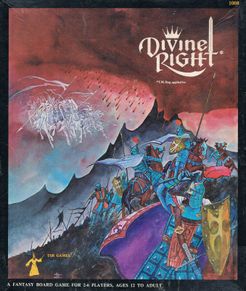 DevGame can now confirm that DevGame Project #6 will be the Basic Rules Divine Right computer wargame, as Alpenwolf has acquired the rights to produce Divine Right-related games, including the original wargame, from the rightsholder. The plan is to complete and release the Basic Rules version first, then add Advanced Rules and 3rd Edition Rules in the future.
Single-player mode versus AI opponents and multiplayer modes with and without AI opponents will be included.
Castalia House also acquired the right to produce novels and RPG materials set in the world of Minaria and utilizing the Divine Right name.
The map is already well underway and is being prepared for 4k screens. The 78 custom map icons still need to be created and the XY ratio needs to be adjusted, but it is otherwise nearing completion.
Subscribe to:
Posts (Atom)