
Showing posts with label Divine Right. Show all posts
Showing posts with label Divine Right. Show all posts
Tuesday, January 19, 2021
The Black Hand (Part 1 of 3)
The first part of Legend of the Black Hand is on the Divine Right Games website. Divine Right subscribers got the first part a week ago! Have you signed up for the Divine Right Games newsletter? Head to divineright.games to sign up today.

Wednesday, November 25, 2020
Minarian Legends
In the upcoming Minarian Legends, the Tower of Zards will have its terrible story told. Below is an excerpt from the chapter on the Tower itself:
The Tower of Zards has borne an evil reputation since pre-Cataclysmic times. The Scarlet Witch King, when he rose against Lloroi rule, raised the mighty Tower with demonic aid and braced its cyclopean stones with potent magic. In the end, the Tower could not shelter him from defeat, but its ruins stood tall despite the devastating upheavals of the Cataclysm in the next generation. Afterwards, the barbarous survivors of the deceased civilization shunned the witchbuilt citadel, not caring to dwell in the shadow of grim, cliff-chiseled walls so often lit from within by some lurid glare whose source seemed to be neither the sun, moon, nor stars. The nomads early began calling the tower “Zards,” a word that translates as “taboo.”
For twelve hundred years the castle stood; those few who trespassed upon it inevitably figured in terrifying legends of doom or madness. Located far from any civilized state, the Tower became known to the outside world only through the discounted tales of an occasional traveler or trader from the barbarian territories. Doubtless, affairs would have long remained just so had not a strange intruder appeared without warning in the Shards of Lor early in the twelfth century.
Have you signed up for the Divine Right Games newsletter? Head to divineright.games to sign up today.
Monday, November 9, 2020
Divine Right Games Website
We are pleased to announce the new Divine Right Games website. http://divineright.games/
If you are interested in getting firsthand news about the upcoming Collector's Edition you can find a sign-up for the newsletter.
In addition to news about Collector's Edition it will regularly showcase artwork, sneak peaks, and lore from Minaria.
Wednesday, November 4, 2020
A Superb Tribute to a Classic Cover
We wanted to pay homage to the original design, but allow the talented artist freedom to interpret the piece in his style. Respecting the work of the original while making appropriate enhancements is foundational to the Divine Right Classic Collector's Edition. The Classic Collector's Edition will be a limited edition of 500 copies of the boxed game utilizing the rules from the second TSR edition of November 1979 which incorporates the first edition errata published in Dragon magazine. After the Classic Collector's Edition is released, a crowdfunding campaign will be conducted in support of the new edition of Divine Right wargame as well as an associated RPG, novels set in Minaria, and lorebooks.

Saturday, October 31, 2020
Divine Right History (Part 3 of 3)
The beginning of Divine Right takes place over 40 years ago, and its continued popularity is a testament to the game's solid design, deep mythos, and great characters. Glenn shared his design notes and the fascinating history of Divine Right with us, so prepare to enter the turbulent world of Minaria from the very start. (Part 2 here.)
DR2: The 25th-Anniversary Edition
Divine Right lay fallow for a long time,
but the collector price grew appreciably—copies going for $200 apiece were not
unusual. A couple of possibilities developed for computer versions of DR,
but both fell through.
As of May 1994, Divine Right seemed to have a chance of rebirth with a game company
called Excalibre in Ontario, Canada. Its president called me, saying that he’d
been hearing for years how gamers wanted the return of Divine Right. He therefore inquired whether I was interested in a
DR reprint. I was very much interested, in fact, and said that I had a lot more
material that I had roughed out over the years and that might be worked into a
new edition. Revision and expansion sounded fine to Excalibre, and I was
encouraged to let my imagination run free. Thereafter, I worked off and on
(mostly on) for four years, coming up with an extensive expansion of both DR and
Scarlet Empire.
By late 1997, alas, it became clear that the
Excalibre project was not going to go ahead, and I saw no choice except to
terminate the contract as of late 1998.
While disappointed at the turn of events, the
time-consuming revision of DR that had ensued had not exactly been wasted. The
mythos of Minaria had become much richer with the introduction of many more
plot elements and characters. The work had been worth doing, and Ken and I at
least had a playtest copy that was fit to present to a publisher. In
retrospect, it’s hard to see how four years could have been better spent.
How true this was became clear in the first part
of 2001, when I received an unexpected call from Shawne Kleckner, president of
The Right Stuf International in Des Moines, IA. He wanted to know whether Divine Right was currently available for
republication. I told him that it was, pointing out that it had undergone a
good deal of revision over the last two decades. The upside of DR’s expansion
was that we could offer him the choice of publishing either the classic game or
the new updated version. Even though Right Stuf was a video-import house and
not a game company, Shawne had been fascinated by Divine Right from his first acquaintance with it and thought that
the game would be a good product for Right Stuf, as its long-awaited revival
would be a service to the game community.
Shawne called back a week later with a definite
offer. He wanted to call the Right Stuf publication the “25th Anniversary
Edition,” which at that time would be accurate only if one dated the design
from the earliest prototypes. Ken and I signed shortly after. We worked hard at
polishing rules to final form and in revising and expanding the Minarian
Legends. The game was printed and ready to ship by the end of 2001.
Over the next few months, the congenial Shawne
Kleckner and his sister, Kris, impressed us with their enthusiasm for the
project.
The Stormriders
Even while Ken and I were still working on DR2,
I had believed that Scarlet Empire
might never be published. I wanted fans who bought DR2, though, to have the
excitement of having the whole of Minaria engaged against a single powerful
foreign invader, even if this invader could not be the
Scarlet Witch King. It would be necessary for the invader not to have an
in-play hinterland of his own. I decided to use a sort of Genghis Khan-type of
intruder to stand in for the nefarious Scarlet Witch King.
My first choice for their name had been “the
Storm Bringers” or “the Flame Bringers,” but author Michael Moorcock had first
dibs on those names. While names, technically, cannot
be copyrighted, I had no reason to step on Mr. Moorcock’s toes. The first
fallback name for my marauders was “Stormriders,” a term that was used
variously in stories and movies and so seemed to be available for fair use. So
that is the name I used.
It was not hard to introduce faux Mongols into
DR2. Already I had worked out rules for a similar type, the Eastern Horsemen
(which remedied the lamentable lack of barbarians on that huge eastern border
of Minaria). These lesser barbarians were suggestive of the Huns, Turks, and
Magyars that perplexed Eastern and Central Europe in the Middle Ages before the
Mongol explosion.
Historically, the Mongols suddenly arrived as
strangers into Europe, as steppe nomads tended to do. They seemed bent on
savage war and conquest, although there had been no real causus belli and, up to then, no significant interaction between
the Continent and Mongolia. To guide the martial actions of the group that I
called “the Stormriders,” I adapted the rules already crafted for the Scarlet
Empire. They were moderately modified to fit the slightly different
circumstances. These borrowed rules are to be seen in particular in the
Minarian vassal rules.
The author looks forward to the continuing possibility of some future Scarlet Empire release. If current plans bear out, it is not impossible that the victorious Stormriders will clash at the borders of Girion with a primed and ready Scarlet Witch King, and two evil empires will send their elite minions and dejected vassals into monumental battles in many lands and climates.
DR2B
When DR2 arrived, Ken and I were surprised to
find that the product differed greatly from our design. Things had been changed
and added without the opportunity for the designers to advise. And the changes
had been bold and risky: some old DR1 rules had been restored without being
integrated smoothly with the rest of the rules as they stood after revision.
This resulted in the problems that were cited by some buyers. I offered an
errata to address the worst of the problems, and the Kleckners posted it on
their company’s website. The errata collection is considered to be the
DR2B edition, a supplement to what we thereafter would refer to as DR2A.
Another unfortunate aspect of the development
was that the recommended color scheme for the counters and map had not been
followed. The changes were not always aesthetically or practically pleasing.
Some of the new hues were printed too dark or too garish, as in the kingdoms of
Zorn (dark purple) and Pon (dark red). Another surprise was that Right Stuf’s
designers had decided to print all non-kingdom counters in black and white.
Also, the counter sheets were not die-cut but only perforated and not very deeply,
making it hard to get a good, clean separation.
On the other hand, Shawne had been interested in
the history of the design and included a CD that contained PDF files of early
game parts, as well as the complete Minarian Legends. Another feature of the CD
was printable archive files of all the counters, allowing the purchaser to
print quality replacements as needed.
While mistakes had been made in the DR2A
edition, the creators were determined not to let the perfect gainsay the good
and did all they could to support DR2B. At first, the publisher had hopes that
the market would support a release of the companion game, Scarlet Empire. Alas, due to apparent difficulties encountered by
The Right Stuf, on which I can’t elaborate because we were not well briefed on
this aspect of the project, the company decided that one game was enough. The
option on Scarlet Empire was allowed
to lapse quietly, and The Right Stuf made no request for its extension.
DR2C and DRX
Many fans were unhappy with the problem-ridden rules
of DR2A and even with the DR2B supplement. Stan Rydzewski, a fan with a flair
for technical writing, contacted me about doing a new edition of rules, one
that would include a few new counters I had belatedly come up with and the
graceful integration of the errata into the body of the rules. Also, for a
period of months, Stan asked many insightful questions that further improved
the game. The documents that came to be known as “Stan’s rules” were
posted on the Yahoo DR site in 2002. We consider that to be the DR2C
edition.
But DR2C had no index, so another fan of
considerable writing ability stepped forward, J. McCrackan. He added an
index and made additional suggestions for revision. I received an
individual copy, but this was just the groundwork for the full version of the
current DRX edition, which has been revised through the processing of thousands
of intelligent questions from J and other players. J also fully
reorganized the rules and introduced the labeling of optional rules by numbers
of hierarchical complexity—a good idea that makes rules consultation
easier. What’s more, many additional counters have been added to the game,
such as traitors, priests, jesters, and others. Some players are adamant
about sticking to DR1, but those who consider the sky the limit for the game
will value J’s rules, I have no doubt.
Elements of a Classic Game
As I have said, Divine Right has been called a classic. This is something every
designer wants to hear, but what goes into making a classic? At the outset,
Kenneth and I were simply looking to achieve a lively, playable,
fantasy-military system. By the indefinable chemistry of such things, we had
worked out a straightforward military-political-diplomatic engine that was able
to support both a subtlety of strategy and lots of rapid action. The system
also turned out to have a remarkable flexibility that allowed a large array of
special options to be introduced as add-ons. These options, such as the special
mercenaries and the magic items, convey much of the colorful and madcap spirit
of things Minarian.
Over the years, the designers have had time to
reflect upon those elements that have led to DR’s enduring popularity. It seems
to this writer that the most successful fantasy games are those that skillfully
distill the ideas presented by a imaginative novelist. SPI’s War of the Ring and Chaosium’s Elric! and Stormbringer are two such games. Worlds created specifically for
board games, by and large, have been famously disappointing. Avalon Hill’s Dark Emperor and White Dwarf’s Demon Lord, to name but two, offered
many characters and much magic, but they failed to engage the imagination.
SPI’s Swords and Sorcery, full of bad
jokes and patronizing apologies for the fantasy genre, suggested that SPI,
mostly a modern-armor company, was out of tune with a growing part of its
customer base. This base was being schooled in fantasy role playing and tended
to be attracted to the idea of mythic heroism. When such gamers found what
they were looking for, they responded well, and we still hear from
enthusiastic people who discovered Divine
Right at the close of the Seventies.
Why were there not more and better military fantasy board games? It seems that these were not the most market-successful kind. Why not? The publishers tended to blame the genre itself instead of their poor presentation of it. White Bear, Red Moon (retitled Dragon Pass and re-released by Avalon Hill) is a notable exception to the board-game-without-a-novel; in fact, it became the inspiration for a successful role-playing release, RuneQuest. The latter also was picked up by Avalon Hill. That Chaosium president Greg Stafford was a fantasy editor/writer in the semi-pros may not be irrelevant. A memorable fantasy board game has to be built like a good story, utilizing character, atmosphere, and situation.
Divine Right Games is proud to be part of the next chapter in the story
of this classic game with the forthcoming Divine Right classic collector's
edition.
Friday, October 30, 2020
Divine Right History (Part 2 of 3)
The beginning of Divine Right takes place over 40 years ago, and its continued popularity is a testament to the game's solid design, deep mythos, and great characters. Glenn shared his design notes and the fascinating history of Divine Right with us, so prepare to enter the turbulent world of Minaria from the very start. (Part 1 here.)
DR1: The Classic Editions
We sent the finished prototype to TSR, Inc. of Lake Geneva, Wisconsin. Within a reasonably short time, TSR’s new products chief informed us that his staff liked Your Excellency, and he was authorized to make us an offer of publication. Once the development staff began to work on Your Excellency in earnest, Kenneth and I received word that the title would be changed to Divine Right. We were fond of “Your Excellency” but soon grew fonder still of “Divine Right.” Further, we had originally called all the monarchs “kings” and now were asked to come up with a wider variety of titles (aided by a kindly developer who had enclosed a long list of suggestions). We also were asked to provide some background material for the world, such as short descriptions of the kingdoms and the scenic hexes. As the seasoned fictioneer on the team, it fell to me to define Minaria.
Although the game world was created without a real background story, the outline of Minarian society came easily enough. As a fan of the theories of Immanuel Velikovsky and of the parallel concept of Robert E. Howard’s Hyboria, I divided Minarian history into periods before and after the “great Cataclysm.” Before the Cataclysm, the Minarian continent had enjoyed a kind of Pax Romanum, ruled by a proud, overbearing, but basically benign species of high elf, which I called the Lloroi. The Cataclysm that followed took much of Minaria back to the Stone Age, but enough culture survived to allow a fairly rapid restoration of civilization. By about 500 A.C. (After the Cataclysm), Minaria had achieved about the same level of culture as Europe possessed in 500 A.D. (Though Europe fell to a nadir at that time, Minaria had fallen much lower but managed to climb back a bit.)
Developing the demihuman races, which fantasy
fans know so well from Tolkien, called for a special measure of care. Rather
than treat the Goblins and Trolls as evil creatures befitting their origins in
the mythology of the Underworld, I addressed them as alien races—different from
men, of course, and rivals, but not ideologically evil. The Elves and Dwarves
came in for a little satire to set them apart from the stereotypes already
abroad in the gaming culture. Hillbillies and gold miners inspired my concept
of Minarian Dwarves, and a combination of Imperial China and the Third Reich
were models for the Elves.
The background material seemed to fit the bill
as far as TSR was concerned, and it was published with the game in 1979 as an
appendix to the rulebook. I had every reason to believe that this was all that
I would ever be allowed to tell about Minaria.
Minarian Legends
To my delight, shortly after the release of the game, I received a request from the editor of The Dragon magazine in which he proposed a series of essays to supplement Divine Right. His idea was to publish a full-length article for each kingdom and each character of Minaria. I estimated that it was a job that would run the length of a fair-sized novel. As a struggling fictioneer with too little demand for my work, I accepted the task gladly. Over the course of about two years, I wrote approximately ten pages per month. These became a regular feature called “Minarian Legends” in The Dragon.
The editor at The Dragon soon left his job, but his successor was equally
supportive of Minarian Legends. The series continued to its logical conclusion,
comprising twenty installments. My detailed history of the Minarian continent
consisted of some 60,000 words, from the Cataclysm to about the year 1350 A.C.
Lately, these old pages became the basis of a
full-length novel, The Ship of Huisinga,
the first book of a projected trilogy that I sometimes call The Matter of Mivior, which will be published by Castalia House in 2021.
In any case, writing the first novel and
planning others has enriched this writer’s awareness of things Minarian. These
include the development of the cult of Huisinga under the heroine Sankari—the
most unlikely of missionaries—as well as the origin of the Tail People, the
strange legacy of the heroine Trouble, and many another detail that has done
much to flesh out Minaria as a real-life place.
Scarlet Empire
From its release in 1979, Divine Right proved to be as popular with the public as its
designers could have hoped. If memory serves, the first run was about 20,000
copies. About a year after the first release, TSR put out a revised edition of
10,000 copies more. Not too long after the release of the game, Ken and I had
sent in some errata and suggestions for changes. Some of these were included in
the second edition. In a particular issue of The Dragon (Vol. IV, No. 8, #34 Dec. 1979), TSR executive Mike Carr
presented the creators’ errata in a column parallel to one giving TSR’s new
official revisions to the rules. This article allowed players to update their
first-edition copies without having to buy a new copy.
Encouraged by a strong fan response, Kenneth and
I worked up a sequel called The Revolt of
the Scarlet Empire. It consisted of a map that fit contiguously to the
Minaria we already knew, one that displayed the kingdoms and empires of a
southern subcontinent, which I called Girion. To make it strikingly different
from Divine Right, we developed the
Scarlet Witch King, an entity previously mentioned in the original rules and
again in the subsequent Minarian Legends.
We wanted to avoid the criticism that the new
game was just a second Divine Right
on a new map. We offered more—much more. The basic game of Scarlet Empire plays much like a good, clean game of DR, but
because fans had liked DR’s naval action, we incorporated more sea and more sea
power into the new map and counter mix. Optional rules present several
scenarios in which the Scarlet Witch King, the bane of the ancient Lloroi
Empire, had returned to subjugate the free kingdoms of Girion under a “scarlet
empire.” Many new special mercenaries came aboard, and so did many more magic
items. We created the optional rules for curses, and the Scarlet Witch King was
provided with enough heavy-duty sorcery to make the Eaters of Wisdom look like
paupers, magic-wise.
Scarlet Empire offers a Revolt scenario
wherein the subjugated kingdoms rise against an imperial tyranny; a Conquest
scenario, simulating the Scarlet Witch King’s original blitzkrieg that had
swept the subcontinent; and even a Crusader scenario that links the two games,
featuring the armies of the north coming south to help free the Scarlet Witch
King’s oppressed vassals. The Scarlet Witch King repaid the compliment with an
Invasion scenario, in which a secure Scarlet Empire boldly invades Minaria from
the south edge of the DR map. There is also the option of a two-map supergame.
TSR’s new-products department expressed interest in the proposed sequel, and the prototype was sent to them in the summer of 1980. Alas, despite our best hopes and expectations, even while SE was undergoing playtest, the decision came down from TSR to take the original Divine Right off the company’s back list. That event precluded any further consideration of SE. Well, whoever said that TSR never made any mistakes?
Part 3 coming tomorrow... And speaking of classic editions, below is the penciled image of the cover for the Classic Collector's Limited Edition boardgame.

Tuesday, October 27, 2020
Divine Right History (Part 1 of 3)
The beginning of Divine Right takes place over 40 years ago, and its continued popularity is a testament to the game's solid design, deep mythos, and great characters. Glenn shared his design notes and the fascinating history of Divine Right with us, so prepare to enter the turbulent world of Minaria from the very start.
By Glenn Rahman
Divine Right was originally published in 1979, revised in 1980, and went out of print in 1982. The game had been very popular, but its designers, my brother Kenneth and myself, expected that DR would simply pass out of sight and out of mind like so many other games before it. To our surprise and gratification, it kept appearing at conventions as a tournament game long after it had become unavailable. Every now and then, we were contacted by persons asking if it was ever going to be reissued. More recently, the word “classic” began being applied to Divine Right, and the designers dared to hope that we had perhaps managed to create something enduring. In 2002, The Right Stuf International, Inc. published a 25th-anniversary edition of Divine Right, putting the game back in print for the first time in twenty years.
Your Excellency
In the early Seventies, Kenneth and I were already avid game-experimenters, mostly with the Parker Brother’s Risk system, when we encountered a copy of Avalon Hill’s Tactics II. Unfortunately, while there were things to learn from that game, it rated very low in the excitement category. But the appearance of Tactics II was our alert that some interesting things were happening in the gaming scene. In the fall of 1974, this writer encountered a large Avalon Hill selection in a Minneapolis department store and bought Third Reich on the spot. The next year, I subscribed to SPI’s Strategy and Tactics. Those were salad days, when even games as wretchedly conceived as Oil War and Revolt in the East got thorough and repeated playing.
Soon the designers were gaming regularly with friends. By 1977, we realized that we had learned enough to leave Risk behind and start designing in the state of the art. The first serious effort carried all the way to conclusion was a fantasy game that we called Your Excellency. Divine Right players would promptly recognize Your Excellency as the prototype of DR. Some of the names, the CRT-less combat system, the diplomacy system, and the kingdom cards were all present.
I had been a frequent short-story writer for the semi-pros and understood the strength that good characterization gives to a story. One night, while Ken and I were play-testing Your Excellency on the kitchen table, it suddenly occurred to me to ask, Why couldn’t a board game have characterization, too? The idea for monarch-personality cards fell easily into place, and it worked even better than expected. From that moment on, we knew we had a good thing going.
But the differences between the prototype and the eventually-published game by TSR, Inc. were huge. The original map was rather austere in the manner of an SPI release. Ken and I had included Elven and Trollish kingdoms, but we had provided no magic. None. Further, we had only six special mercenaries: Juulute, Schardenzar, the Black Knight, Urmoff, Ogsbogg, and Hamahara. The barbarian element was represented by nothing more than a small kingdom.
The prototype was dispatched to Metagaming of Austin, Texas. During its long evaluation period, Kenneth and I continued to sample the new bounty of the gaming world. Kenneth experimented with a different map, but we never actually got around to using it in any play tests. In the interim, we discovered the Chaosium game of White Bear, Red Moon. This game was something new in our experience: a game of heroic fantasy. A few routine spaceship-battle games existed already— Excalibre had a pioneering effort to create a fantasy game, one they called Atlantis. Meanwhile, SPI had the execrable Sorcerer, and there was a fantasy-tactical game called Dungeon from TSR. For some reason, we had not bothered to examine the rest of the field, such as Fact & Fantasy’s Helm’s Deep or TSR’s Battle of the Five Armies. So within our frame of reference, we addressed the innovations of WBRM with great interest.
There was much in White Bear, Red Moon that we liked, though there was much that we couldn’t relate to. For instance, WBRM seemed to have no clear line demarcating the world of the gods and the world of men. As a reader of mythology, I could understand this—sort of. The world order in Stafford’s Glorantha resembled that of The Kalevala or numerous primitive mythologies, including that of the American Indians, where characters grade from hero to sorcerer to god with hardly any warning where one ended and the other began. Kenneth, on the other hand, was a J.R.R. Tolkien enthusiast, and my own fantasy tastes leaned toward Robert E. Howard, H.P. Lovecraft, and Clark Ashton Smith. In all these authors’ writings, there was a difference between gods and men; fantastic things were possible, but an understandable barrier remained between the different states of reality.
Further, as far as the conventions of WBRM went, it was hard for us to identify with heroes who could, like the Irish champion Cuchulain or the Indian hero Arjuna, take on whole armies single-handedly. From our point of view, a Julius Caesar might make the deciding difference in a battle with the Gauls, but could J.C. have faced the host of Vercingetorix all by his lonesome? Never! A man is a man and an army is an army. Nonetheless, WBRM had something we needed to learn: the manner in which magic might be fitted into the world of military affairs.
The Metagaming copy of Your Excellency finally came back rejected in 1978. Like most creative people, we decided that the editors involved just didn’t appreciate quality and innovation. Nonetheless, months had already passed, and we had some new ideas that we wanted to introduce to the game. Kenneth set energetically to work redesigning the map, and before long, he presented me with an entirely new map done in a jolly-looking antique style, one that would be recognizable as the rough draft of the published classic. It had a colorful and richly satiric quality that would inspire much of the subsequent design as well as much of the writing for the yet-to-be created Minarian mythos.
Kenneth had most of the place names written in by the time I first saw the map, and it was only left for me to help with the details and the polishing. The Crater of the Punishing Star was one of my additions, as was the Altars of Greystaff. I also contributed the names of Zorn, Pon, Minaria, and the Invisible School of Thaumaturgy. Zorn came from out of a phone book, and Pon was the name of a mountain kingdom created in a story cycle of mine, only two episodes of which ever saw the light of day in amateur publication. Minaria was the name of a kingdom I had used in an earlier bit of fictional juvenilia. I think that I was unconsciously echoing “Mnar,” an arcane land mentioned by Lovecraft, or maybe even Minnesota, my home state.
Kenneth and I already had a sound movement-combat-diplomacy system in the original Your Excellency. What the new version required from us was magic, chrome, and detail. The gadgets of the Eaters of Wisdom were worked out quickly, and we took inspiration from the corpse-loving wizards of Clark Ashton Smith’s short stories to create the Black Hand.
Working out the new edition of Your Excellency was amazingly easy. The new game world seemed to leap spontaneously to life. Juulute, the Black Knight, Schardenzar, Urmoff, Hamahara, and Ogsbogg were preserved, but their abilities and powers were expanded and fleshed out. The Bilge Rat and several special-mercenary combat units were added also. Just before we finalized the rules, we came up with the Wandering People based, of course, on Hollywood’s take on Gypsies.
Part 2 coming soon...
Monday, October 26, 2020
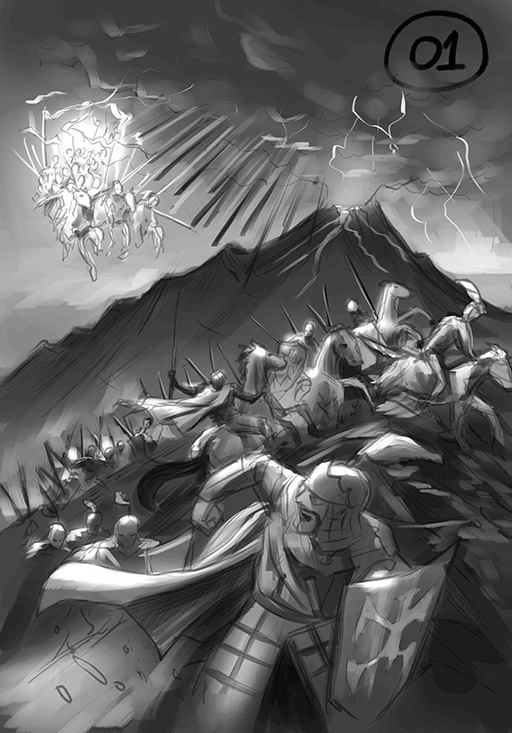
Divine Right classic edition cover
Unfortunately, it's not possible to utilize the original painting that appears on the original Divine Right 1979 edition because TSR never returned it to the Rahmans. So, we have to recreate it. Below is the variant of the draft that Glenn Rahman has selected for the classic collector's limited edition.
Monday, October 19, 2020
Divine Right classic collector's edition
We're now delving into board-and-counter wargames as well as computer games, as Divine Right Games is in the process of planning a crowdfunding campaign for a Divine Right RPG as well as the release of Divine Right 4th Edition.
However, since this will be our first board-and-counter game, we've decided to test the production waters by first releasing a Classic Collector's Limited Edition of the original 1979 TSR 2nd edition. No more than 500 copies will be produced, and it will be a straight reproduction of the rules, map, and counters. The reason we have chosen the 2nd edition (November 1979) over the original (March 1979) is that the difference between the two editions is little more than the errata fixes that were first published in Dragon #34 and subsequently incorporated in the November 1979 release.
We'll have to do a new cover for the box, but we intend to keep the counters and map exactly the same, although the blank counter spaces will allow us to add some additional counters, such as variant King counters and extra army counters. The manual will have a glossy full-color paperback cover and feature the signature of designer Glen Rahman. Watch this space for further developments.
Saturday, October 17, 2020
WARLEADER
Nearly two decades ago, I began designing Warleader, a tactical fantasy game inspired by Advanced Squad Leader. While I never finished the design, the world I created for it turned into Selenoth, which served as the backdrop for the Arts of Dark and Light novels, including Summa Elvetica and A Throne of Bones.
Now that we're working on both computer and board game editions of Divine Right, I had a great conversation with Glenn Rahman concerning a tactical adaptation of Divine Right, tentatively called Divine General. He was enthusiastic about the concept of combining ASL-style tactical combat with his world of Minaria, which led me to the idea that Warleader could be converted from a single world setting into a generic tactical combat system for which modules dedicated to different fantasy worlds could be created. The idea is to start with the board games and VASSAL adaptations, then eventually make the transition to full-blown computer games.
It's an idea, anyhow. Here are sections 2 and 3 from the Warleader rules, which addresses the components and the sequence of play.
2. COMPONENTS
Four 8”x11” full-color mapsheets
Four sheets of cardboard playing counters
One 30-page rulebook
One 8”x11” page of charts
Two ten-sided dice
2.1 MAPBOARDS: The geomorphic mapboards represent the terrain. Each mapboard is divided into hexagonal sections called hexes. Each hex represents a piece of land approximately fifty yards across. The various images shown on the mapsheets represent different terrain elements which can effect line-of-sight, movement, and combat results.
2.11 HEX COORDINATES: On each of the four mapsheets, every hex is marked with a unique alpha-numeric identifier. If the mapsheet is placed lengthwise, the upper-leftmost hex will be marked A1 and the lower-rightmost hex will be marked K20. These hex coordinates are used for unit placement and reference purposes.
2.2 COUNTERS: The cardboard counters representing troop formations, individuals, and creatures are known as units. Other counters used to provide information during the game are known as markers.
2.21 CLASSES: Units are divided into five classes: Infantry, Cavalry, Artillery, Individual, and Creature. These classes are divided further into specialized types based on Allegiance.
2.22 INDIVIDUAL COUNTERS: Counters representing Leader, Hero, and Magic-User units are known as Individual Counters. (IC). Counters representing Infantry, Cavalry, and Artillery Counters are known as Group Counters. (GC). Units of the Creature class may be represented by IC or GC, depending on the specific unit.
2.3 UNIT INFORMATION: Each unit counter is marked with several numbers and symbols that convey specific information about the unit.
2.31 QUALITY: Elite, Veteran, Green, and Conscript. Units which have a Quality rating consisting of a number instead of a letter are considered to be Veteran units if the number is greater than three, otherwise they are considered to be Green.
2.32 ATTACK FACTOR: The leftmost of the three numbers across the bottom of a unit counter is the unit’s Attack Factor, (AF), which represents the unit’s ability to attack in combat, prior to any modification.
2.33 DEFENSE FACTOR: The middle of the three numbers across the bottom of a unit counter is the unit’s Defense Factor, (DF), which represents the unit’s ability to defend in combat, prior to any modification.
2.34 MOVEMENT FACTOR: The rightmost of the three numbers across the bottom of a unit counter is the unit’s Movement Factor, indicating how many Movement Points may be spent by the unit in one turn.
2.34 MORALE LEVEL: The number on the right side of the counter is the unit’s Morale Level indicating the unit’s ability to perform as a combat unit. There are four Morale Levels, Fit, Shaken, Broken, and Fleeing. When this number is exceeded during a DR due to a Morale Check, the unit is considered to have taken casualties and its status is decreased by one level.
2.36 RANGED ATTACK CAPABILITY: Each unit counter is marked with numbers and/or symbols that convey information about the unit's ranged attack capabilities.
2.37 LEADERSHIP: Each unit counter is marked with several numbers and symbols that convey information about the unit's ability to rally itself without the benefit of a Leader counter.
2.38 MAGICAL CAPABILITY: Each unit counter is marked with several numbers and symbols that convey information about the unit's magical capabilities.
2.4 BLOOD AND BONE DICE: The ten-sided red die is henceforth referred to as the Blood Die. The ten-sided white die is henceforth referred to as the Bone Die. The significance of these distinct identities will be explained later in the rulebook.
2.41 THE DOUBLE-ZERO: A roll of the Blood and Bone dice resulting in a matched pair of zeros equals zero, not one hundred. The highest possible unmodified roll is a ninety-nine. However, the double-zero is a special roll that may lead to some unique results.

3. SEQUENCE OF PLAY
3.1 PLAYER TURN: Each Game Turn is divided into two Player Turns. The player who controls the current Player Turn is designated the Attacker for the duration of the Player Turn; the other player is designated the Defender.
3.11 ORDER PHASE (OP): Broken and disrupted troops are rallied. Spell point counters are distributed. Prayers are made. Existing spells are updated. Supernatural beings make Planar Checks.
3.12 SKIRMISH PHASE (SP): Attacker’s magic users may cast spells. Attacker’s range troops may fire. Attacker’s cavalry may declare charge.
3.13 MOVEMENT PHASE (MP): Attacker’s magic users may cast spells. Attacker’s cavalry charges executed. Attacker may move troops. Attacker may build field defenses. Defender’s range troops may fire.
3.14 DEFENSE PHASE (DP): Defender’s range troops may fire. Defender’s magic users may cast spells.
3.15 BATTLE PHASE (BP): Melee combat resolved. Attacker’s magic users may cast spells. Defender’s magic users may cast spells. Attacker’s range troops may fire
3.16 RETREAT PHASE (RP): Broken troops must retreat. Fleeing troops must flee. Units marked with a Retreat counter must retreat. Supernatural beings removed from board
3.17 ADVANCE PHASE (AP): Attacker’s Fit troops may advance one hex into adjacent, open hexes in their Front facing. Attacker’s non-Broken troops may rotate one hexside.
3.18 SECOND PLAYER TURN: Upon completion of the Attacker’s Advance Phase, the first Player Turn is ended. The Attacker now becomes the Defender, the Defender becomes the Attacker, and a new Player Turn begins, repeating the above sequence. Upon the completion of the second Player Turn, the current Game Turn is ended and a new Game Turn begins.
Tuesday, August 1, 2017
Battle Report: July 29th
Another week, another war in Minaria. This game was just a quick two-player one between Werepuppy(as Shucassam and later Rombune) and myself(as Immer). Early on, Immer managed to get Muetar and Hothior as allies. Shucassam gained Rombune and summoned barbarians to aid their campaigns. From here, we begin.

The most pivotal early battle in this session happens just outside Beolon on the Downs. A roughly even fight between the massed forces of Immer and the Shucassami alliance, ends poorly for Shucassam. With the monarch of the desert kingdom perishing in the battle. Shucassam falls into confusion, its attempt at hegemony failed.
Tuesday, July 25, 2017
Battle Report: July 22nd
Again we come to Minaria. This week is actually a continuation from the July 1st game, between lastRedoubt, Jared, and yours truly. Who are playing as, the Trolls, Pon and, the Black Hand respectively.

Last time, Pon was far and ahead in the lead in both power and victory points. They count both Shucassam and Muetar as their allies. The Trolls were second in power but, had allied themselves with Zorn and Hothior. The Black Hand is last, having lost allies left and right, including Shucassam and Immer. From here, we begin.
Tuesday, July 18, 2017
Battle Report: July 16th

Monday, July 3, 2017
Battle Report: July 1st
Another week of war in the world of Minaria. This week is a three way struggle between the kingdoms of the Trolls, Pon and the Black Hand. Who are played by special guest lastRedoubt, Jared and, yours truly respectively.
The opening of the game was fairly slow. The Black Hand as able to acquire Immer as an ally.The Trolls were able to gain Zorn. Pon ultimately gains Muetar as an ally to use to its ends. From here we begin.

Zorn and Immer ended up at each other's throats in the mountainous regions between the two kingdoms. Here the Gap Castle holds the line against the Goblin hordes while under siege.
Tuesday, June 27, 2017
Battle Report: June 25th

The Gap castle ended up a major flash point between Immer and Zorn, begin host to the majority of combat in Minaria so far.
Monday, June 19, 2017
Battle Report: June 17th
Another week, another game of DIVINE RIGHT. The game this week is a continuation of last week's between, Jared, Werepuppy and yours truly. With the kingdoms being, the Dwarves, Pon and Immer respectively.

Last time, Immer utterly dominated Northern Minaria, effecting great victories against Pon with it's alliance. Near the end, Pon was focused on nursing its wounds and the Dwarves had stepped up their attacks. From here we start.
Monday, June 12, 2017
Battle Report: June 10th

Monday, June 5, 2017
Battle Report: June 6th
Minaria Awaits, in a another game of DIVINE RIGHT. There were two games last weekend but, I am going to focus on just one. This game is a continuation of the ADVANCED one from last week. Elfland, Hothior, Pon and the Eaters of Wisdom, are played by lastRedoubt, Werepuppy, Jared and yours truly, respectively.

In the last game, lastRedoubt was on a major tear as Rombune, forming a grand alliance with Shucassam and Muetar. Unfortunately, Rombune's monarch died after being chased down by Hamahara the Air Dragon, while fleeing from an unsuccessful campaign in Hothior. Losing his first kingdom lastRedoubt rejoined as Elfland. Hothior, weakened following their conflict with Rombune, now faces an invasion from the Eaters of Wisdom. Who have begun to siege their northern fortress of Tadafat. To the east, Pon is slowly coming together, their plans are still indeterminate however. From here we continue.
Monday, May 29, 2017
Battle Report: May 27th
Another week, another trip to the world of DIVINE RIGHT. There's a new ADVANCED four player game this week. Pon, Hothior, Rombune and the Eaters of Wisdom vie for Minarian Hegemony. Played by Jared, Werepuppy, lastRedoubt and yours truly, respectively.

At the start, the majority of the player kingdoms are clustered in the west, Pon alone being relatively isolated in the east. Besides this, Hothior and Rombune are both naval powers albeit Rombune has a slight edge in naval power. Notably, I managed to get one of the Magiciains in this game, they start with lots of magic but, almost no army.
Monday, May 22, 2017
Battle Report: May 21st
Minaria is in flames this week, with not one but, two different games. The first, is a BASIC game between Jared, DR team producer Spudbox and, myself. With the player kingdoms being Zorn, Rombune and, Mivior respectively. The second is the epic conclusion to the ADVANCED game last fought on the 6th of May, between Jared's Shucassam, Werepuppy's Pon and, my own Mivior.

Early military moves had the Miviorines gather their forces for an attack on the capital of Rombune, Golkus. Landing both their regular expeditionary units and those of their ally, Shucassam.
Game One
In this Minaria, Zorn, Rombune and, Mivior struggle for supremacy. Things start as they usually do with armies being consolidated and allies recruited. In the early phases, Mivior managed to ally the Kingdom of Shucassam. Whereas Rombune took several turns before they were able to ally Hothior giving them a rough naval parity with Mivior. Zorn is eventually able to make allies with their southern neighbors the Muetarians.
Subscribe to:
Posts (Atom)