
Tuesday, January 19, 2021
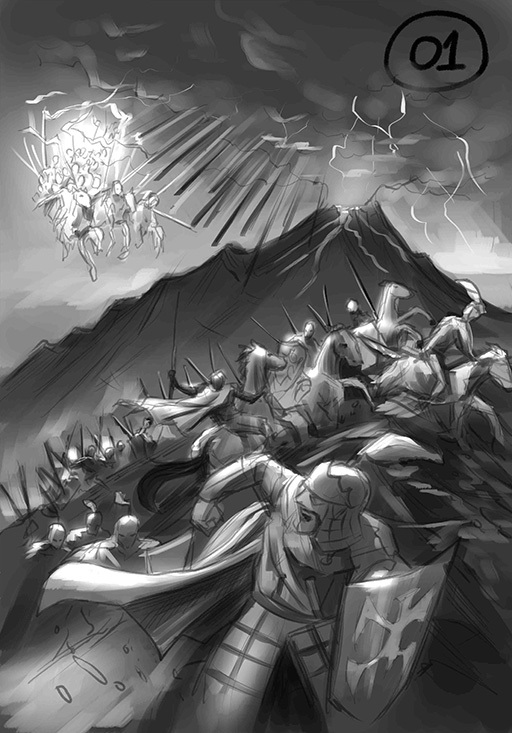
The Black Hand (Part 1 of 3)
The first part of Legend of the Black Hand is on the Divine Right Games website. Divine Right subscribers got the first part a week ago! Have you signed up for the Divine Right Games newsletter? Head to divineright.games to sign up today.

Tuesday, December 1, 2020
Designed to cheat
It appears that a major game company, which I would assume is Blizzard, is attempting to design cheating right into its esports platforms, based on a report from Crazy Days and Nights, of all places:
This A list gaming company which is a merger of two big companies has a patent in which their match making services (traditionally random based on certain parameters) can be rigged in order to influence in game purchases. If one reads between the lines, this implies that all random events in their games are determined server side.
The ramifications of said patent were present for all to see at the online collectible card game world championship in 2019. In said tournament, the company fully rigged random results left and right in order to obtain political favor with China. This incident occurred within a few weeks after the company banned multiple players for speaking out against Chinese oppression of Hong Kong.
Examples of rigged events on behalf of the Chinese player included always having certain key cards in her hand by X turn, always going second when playing a deck that greatly benefits from going second, or random results from cards played always swinging significantly in her favor.
Many people who watched the live stream of the event suspected the fix was in, but had no proof. It is unknown if the player herself was in on it (assuming no due to innocent until proven guilty).
This is potentially the worst scandal in esports history.
Here’s the patent that can prove the fix is in. The one that by reading between the lines, a lot can be inferred. I also quoted some of the more disturbing passages that prove that the company can rig random events (quotes are about matchmaking, which is supposed to be random).
“In another example, if a player has been performing poorly (e.g., getting killed at a rate higher than the player's historical rate), the scoring engine may dynamically adjust one or more coefficients to match the player in a game that will improve the player's performance. For example, the player may be matched with easier opponents, matched with better teammates, and/or placed in a game that is more tailored to the player's preferences (e.g., players that play in games more closely aligned with their preferences tend to perform better).
To fine-tune the matchmaking process, the system may include an analytics and feedback engine that analyzes player and match data to determine whether a given match was good. A match may be deemed "good" when a player is determined to have enjoyed gameplay associated with the match based on one or more quality factors that are used as a proxy for player satisfaction. The quality factors may include, for example, a duration of a gameplay session (e.g., via analysis of player historical data), player psychological state (e.g., frustration level), and/or other information.”
I don't see how this is going to be legal, much less even remotely acceptable to the players being manipulated by the patented algorithms.
Wednesday, November 25, 2020
Minarian Legends
In the upcoming Minarian Legends, the Tower of Zards will have its terrible story told. Below is an excerpt from the chapter on the Tower itself:
The Tower of Zards has borne an evil reputation since pre-Cataclysmic times. The Scarlet Witch King, when he rose against Lloroi rule, raised the mighty Tower with demonic aid and braced its cyclopean stones with potent magic. In the end, the Tower could not shelter him from defeat, but its ruins stood tall despite the devastating upheavals of the Cataclysm in the next generation. Afterwards, the barbarous survivors of the deceased civilization shunned the witchbuilt citadel, not caring to dwell in the shadow of grim, cliff-chiseled walls so often lit from within by some lurid glare whose source seemed to be neither the sun, moon, nor stars. The nomads early began calling the tower “Zards,” a word that translates as “taboo.”
For twelve hundred years the castle stood; those few who trespassed upon it inevitably figured in terrifying legends of doom or madness. Located far from any civilized state, the Tower became known to the outside world only through the discounted tales of an occasional traveler or trader from the barbarian territories. Doubtless, affairs would have long remained just so had not a strange intruder appeared without warning in the Shards of Lor early in the twelfth century.
Have you signed up for the Divine Right Games newsletter? Head to divineright.games to sign up today.
The Tower of Zards has borne an evil reputation since pre-Cataclysmic times. The Scarlet Witch King, when he rose against Lloroi rule, raised the mighty Tower with demonic aid and braced its cyclopean stones with potent magic. In the end, the Tower could not shelter him from defeat, but its ruins stood tall despite the devastating upheavals of the Cataclysm in the next generation. Afterwards, the barbarous survivors of the deceased civilization shunned the witchbuilt citadel, not caring to dwell in the shadow of grim, cliff-chiseled walls so often lit from within by some lurid glare whose source seemed to be neither the sun, moon, nor stars. The nomads early began calling the tower “Zards,” a word that translates as “taboo.”
For twelve hundred years the castle stood; those few who trespassed upon it inevitably figured in terrifying legends of doom or madness. Located far from any civilized state, the Tower became known to the outside world only through the discounted tales of an occasional traveler or trader from the barbarian territories. Doubtless, affairs would have long remained just so had not a strange intruder appeared without warning in the Shards of Lor early in the twelfth century.
Have you signed up for the Divine Right Games newsletter? Head to divineright.games to sign up today.
Monday, November 23, 2020
Sit Down, Shut Up, and DIE
According to Eve Crevoshay and her "advocacy" group Take This, the most important thing facing developers today is Diversity, Equity, and Inclusion (DEI). Let me fix it for her: Diversity, Inclusion, and Equity (DIE).
You know it's funny. When I was pitching our new mobile games studio, Dead Reckoning, to major AAA game publishers and some of the top game-focused VC's in the world, *not once* did I get asked what my diversity plan was. I did get asked about the equity plan: As in, how much equity were my other, mostly white, male co-founders getting. If one thing was consistent about my ever-morphing pitch deck, it was a lack of a slide entitled "Veteran Team of Game Makers Committed to DIE". We've raised $10M in funding now and still not a single question about it. So strange!
It's almost as if those smart game VCs looked at all the big game exits over the last few years, observed the composition of the teams, and silently noted that homogeneity seems to actually be a strength. How else could Espoo, Finland become the game development powerhouse it has, when they are so disadvantaged relative to DIE initiatives, having a paltry sub-10% non-Finnish talent pool to draw from. Maybe they noted, as I did of all the acquisitions I assisted with at GC Games, a successful studio in Sweden most often consisted of a bunch of Swedish men. A successful studio in Turkey, a bunch of male Turks.
As for Ms. Crevoshay, it's clear she has never, nor will ever, *create* anything of value herself, so she goes about advocating death for others. I suppose "those who can't do, advocate."
Sunday, November 15, 2020
War Leader cover

DIVINE RIGHT is not the only board-and-counters game we are currently developing. Once we have the counters done and refined for VASSAL, we will start looking for playtesters interested in playtesting WAR LEADER, which can be thought of as an advanced tactical combat game that is to fantasy combat what ASL is to WWII infantry combat. We're looking at it as a system that will initially be constructed for the world of Selenoth, but will allow modules of different fantasy worlds to be developed, so the same system can be applied to scenarios involving everything from the Uruk-Hai to the Cauldron Born, the White Walkers, and the goblins of Zorn.
Friday, November 13, 2020
The Bandits Do Their Laundry
Elder Scrolls Online is currently one of the most popular MMOs with over 15 million players and while I’m sure there are many reasons for its remarkable success, I believe one is that the world is carefully crafted and not just made.
While exploring one of the many dungeon delves across Tamriel, I noticed that the bandits who lived and would soon die by my hand had done their laundry. It was hanging up between a few tents with a desk in it, near some barrels, weapon rack, cooking fire, and various other details like a very nice and out of place chair—all stolen no doubt.
It was completely unnecessary and they could have had the NPC bandits just standing around near some crates, barrels and maybe a fire and nobody would have complained. Zenimax, was not content with that level of detail and immersion so I carefully made my way around the dungeon, slaughtering its inhabitants as I went, to see the details. Remarkably, this sort of immersive detail was scattered throughout a simple dungeon delve.
I believe there is a very valuable lesson for any writer, dungeon
master, game developer, or cartographer: the little details make the world. This
isn’t to say you always have to mention the laundry, but adding small details instantly
adds to believability and immersion.
Think about the most popular fantasy worlds like Middle Earth, Azeroth, the Imperium of Man, Gotham, Krynn, the Star Wars universe, Narnia, Hybora, Westeros, and Tamriel (Skyrim at
least), and they are all filled with depth starting with small details. So take
a moment and add a few small things to your world if you are creating one, or
at least stop and smell the fresh laundry before continuing the slaughter.
Tuesday, November 10, 2020
Conan the Culturally Sensitive
If you're going to bill your game as being true to the spirit of the original source material, one thing you really need to accept is the likelihood that the game is not going to be true to the spirit of some modern sensibilities. The developers of this Conan RPG don't appear to understand that.
We made changes to Conan the Wanderer on a cultural consultant’s recommendations that created a more rounded and well-developed representation of the fictional cultures based on their obviously real South and East Asian counterparts. Word choices were edited throughout for tone, like removing “exotic” and “mysterious” replacing it with a better adjective to describe its people and places, so that players inhabiting eastern characters in their games aren’t just a stereotype of strange, unknown people, and placed them at the center of this book. This was an issue for us in the original version, as it often assumed to paint all eastern characters with the same brush, instead of inspiring a sense of rich societies and cultures.
The material is and always has been wholly faithful to Robert E Howard. We’re not changing anything about the setting or the world. Not a single word of REH’s text has been altered. The only adjustments are being made to the game content itself, or fiction we’ve derived and extrapolated from his works, particularly the way we discuss and present that material.
I'm not saying there is anything intrinsically wrong with a culturally sensitive Conan, although that would arguably work much better as a parody than as a straight-faced RPG. But you can't honestly advertise the game as being Robert E. Howard's Conan.
Monday, November 9, 2020
Divine Right Games Website
We are pleased to announce the new Divine Right Games website. http://divineright.games/
If you are interested in getting firsthand news about the upcoming Collector's Edition you can find a sign-up for the newsletter.
In addition to news about Collector's Edition it will regularly showcase artwork, sneak peaks, and lore from Minaria.
Sunday, November 8, 2020
Dr Frankenstein's Game Design
Game Design legend Chris Crawford explains a fundamental mistake made by many game designers:
One of my most deeply-held beliefs recently gelled for me. Throughout my career, I have devoted my most serious design efforts towards working out the algorithms that form the foundation of my games. My thinking here is so deeply held that only recently have I realized that other people don’t think that way. They think about games or interactive storytelling in terms of graphics, mechanics, user experience, gameplay, and all manner of other minor details. They seem to think that game design and interactive storytelling are just a matter of putting all the right features in place.
Frankenstein’s Mistake
To make my point, I’ll use an analogy based on the Frankenstein meme. The basic strategy used by Dr. Frankenstein was to stitch together a lot of pieces of the body (features) and then ‘animate’ them with electricity. To him, a human being is a collection of pieces: arms, legs, kidneys, lungs, heart, brain, and so forth. Just put them together, give them a jolt of electricity, and you’ve got yourself a human being.
That’s entirely wrong, and it could never work, because the human body is not a collection of pieces; it’s a system of processes. To build a human body, you start with the most elementary processes: cell metabolism. Once you’ve got the biochemistry of a cell working, then you have to design lots of specialized cells: muscle cells, cells that manufacture and secrete special hormones, nerve cells, blood cells, and on and on.
Once you’ve developed the ability to manufacture all the different kinds of cells, you need to start assembling them system by system rather than piece by piece. Perhaps you start by putting together a skeletal system, then adding a circulatory system, a nervous system, musculature… things get very complicated here. But the key point is that you build it system by system rather than piece by piece.
In exactly the same manner, games and interactive storytelling are not assemblages of features, they are systems of processes. People do build Frankenstein games by just stitching together a bunch of features, but the results are as clumsy and stupid as the Frankenstein monster was. If you want to do it right, you’ve got to stop thinking in terms of the conventional features listed above and instead think in terms of the processes that you will build into the design.
What he's talking about here includes my observations on imitative design, but he goes much deeper than that superficial categorization. What he's saying is that it is the interlocking elements that go into the various features of the game, all of which ultimately depend upon the algorithms that create them, that should be the the designer's focus. This simultaneously requires an ability to think in both holistic and highly detailed and technical terms, which is why there simply aren't very many good game designers out there.
To the extent that Crawford believes it is necessary for the designer to write the algorithms, or even comprehend the math underlying them - and I am not saying he does, I'm am only addressing the theoretical possibility - I would tend to disagree. But the designer needs, at the very least, to understand the purpose and the output of the algorithms that underlie the systems of his design.
Saturday, November 7, 2020
Reinventing the Art
This article appeared in the February 2008 issue of Develop magazine.
Last month, Electronic Arts took the unusual, although not unprecedented, step of permitting the release of the source code of Maxis's landmark simulation game SimCity to the public under the Gnu Public License version 3. This is not the first time that game code has been released into the wild, but it is one of the first times that source code from a hit game that was not developed by the notorious maverick John Carmack has escaped the confines of the development house.
Now, it's far too soon to say if anyone will actually do anything interesting with the code, which is named Micropolis due to the need to protect EA's trademarks. But even if a programmer or two manage to come up with something brilliant, it is unlikely that even a creative spin based on a genuinely great game is going to generate much attention due to that which is now the great bane of the game development industry.
To put it in a nutshell, the problem is art. Game art, to be specific, the amount and the expense of it required in games today.
Although my game-playing dates back to the Apple II, Akalabeth, Swashbuckler and the original Castle Wolfenstein, I didn't actually start designing my own games until the MCGA days. There were two options then, 320x200, 256-color resolution or 640x480 with 16 colors. Like most would-be developers, my friend and I began by copying a game that we quite liked that we thought we could do a little better, in our case, Warlords from SSG. Our game was going to be called MythWars, wherein the player was a god from one of the various pantheons, which determined the various army types available.
With such low resolution and a 2D environment, the tiles were so small that two non-artists were perfectly capable of creating what were, at the time, very professional looking graphics. The rolling hills gave way to majestic, snow-covered mountains and the various monstrous infantries and cavalries really looked quite good against the backgrounds. For those who can remember those primitive days, it actually looked prettier than Warlords or QQP games like Conquered Kingdoms. Nowadays, of course, looks crude beyond belief, something a child would be embarrassed to put on Facebook.
We never finished MythWars, as completing college and then leaping right into the exciting new horizon of 2.5D technology turned out to be a permanent distraction. We tried a few different approaches, especially with video capture, but we quickly learned that our art skills had reached their limits and 2.5D required hiring real artists from the local art school. The budget for our first game was only $125,000, which paid for the two full-time artists who worked on it. These days, that wouldn't cover the cost of the graphics used on a single game level.
The problem is that while games are visually incredible these days, they often aren't actually any more fun to play. Consider Guitar Hero, for example. While it's got very realistic graphics, they're really not very important to the game; the player primarily derives his enjoyment from rocking out with something that feels like a real guitar in his hands. It's the interface that's key, not the visuals, and if you think about it, all games really are, at root, is amusement interfaces.
And art isn't only less fundamentally relevant to games than one might think, but its cost actually creates genuine design problems that are completely unrelated to the art itself. Because budgets are so massive these days, more people have to sign off on every project and there's greater financial pressure on games to appeal to the widest possible market. This is not the way to stimulate creativity and design brilliance, but rather imitation and design mediocrity. This isn't anyone's fault, it's just the natural evolution of the industry. If it weren't for the fact that a few of the industry's most innovative minds also happen to be some of its most vastly successful ones, we might all be reduced to developing clones of the latest clones of the previous clones.
Is there a way out of this artistic bottleneck? It seems hard to imagine, since no one wants worse graphics and I don't know very many talented artists who are inclined to work for nothing. Perhaps EA's release of “Micropolis” may hint at the way, after all, an awful lot of game art is pretty similar to the art used in other games. What if instead of releasing game code, developers were to release their old textures and models into an online pool from which everyone could draw as needed, thus reducing the need to draw yet another space laser or oak tree? Obviously, there would still be a need for new art, but at least everyone woudn't be constantly paying to reinvent the dying monster animation.
No doubt there are a million and one reasons why an Internet Art Pool could never come to pass, but in the unlikely event it does, I have some nice 32x32 mountains in case anyone needs them.
Wednesday, November 4, 2020
A Superb Tribute to a Classic Cover
We wanted to pay homage to the original design, but allow the talented artist freedom to interpret the piece in his style. Respecting the work of the original while making appropriate enhancements is foundational to the Divine Right Classic Collector's Edition. The Classic Collector's Edition will be a limited edition of 500 copies of the boxed game utilizing the rules from the second TSR edition of November 1979 which incorporates the first edition errata published in Dragon magazine. After the Classic Collector's Edition is released, a crowdfunding campaign will be conducted in support of the new edition of Divine Right wargame as well as an associated RPG, novels set in Minaria, and lorebooks.

Tuesday, November 3, 2020
The irrelevance of awards
33 years ago, Chris Crawford explained why one should never take awards very seriously in The Journal of Computer Game Design, Volume 1, Number 5.
This is the time of year for annual awards. The pundits gather their wits, their votes, and their courage, and they select the best products of 1987. There’s nothing intrinsically wrong with the idea; nowadays, so many products are released that an annual review of the best products provides needed perspective. Sadly, though, the execution falls short of the ideal.
Consider the annual awards of MacUser magazine. I noticed in their 1986 awards an apparent bias in favor of products that appeared late in the year. I therefore compiled data on the products that won awards and compared it with the review dates of those products. I then carried out a statistical test of the hypothessis that awards are given with no regard for release date. The hypothesis was rejected at better than the .5% confidence level. For you non-statisticians, it means that the awards were grossly biased in favor of recently released products.
Then there is the awards system sponsored by the Software Publisher’s Association. The problem with the SPA awards arises from the fact that the software industry executives who vote for the awards don’t play many games themselves, and so they have no independent basis for making a decision. Determined publishers will send free copies of their games to every elector to jog their memories. It’s not quite the same thing as buying the election, but more than one publisher has mentioned to me the high cost of winning an SPA award.
I don’t mean to pick on MacUser or the SPA — they’re both solid organizations working to improve their systems. I could have picked apart any of the awards systems. These were the most convenient targets. My point is that none of the various awards can stand up to close inspection.
There is a fundamental reason why awards systems are such a mess: there are just too many games coming out each year for any one person to make a fair determination. Consider this: each year, several dozen games companies release several hundred games to the marketplace. It takes at least five hours of playtime to evaluate a game well enough to determine its worthiness for an award. It would therefore require nearly a full-time worker just to play all the games. Who’s got that kind of time to throw around?
The brutal truth is this: most of the people who cast votes for the “best game of the year” have played only a fraction of the hundreds of games out there. Few of them have spent much time with the games for which they vote. In short, it’s a crock. Most of the electors for the Academy Awards have seen the movies for which they vote. Most of the electors for book awards have read the books under consideration. Is it too much to ask the same for games? Apparently it is.
So what should we game designers do about it? We certainly should not institute our own system of awards. Let’s face it, we’re not much better equipped to select the best games of the year. We probably spend more time playing games than most people, but I doubt that any of us are catholic enough in our game-playing to do justice to an annual award.
So I suppose the best we can do is behave graciously when we hear that we have received an award (or, more precisely, our publisher has received the award), thank everybody in sight, take the plaque or doodad home, mount it on the wall, and forget about it. Lord help us all if we start taking these things seriously.
That being said, the CGW games of the year were, for the most part, well worth playing. But then, as a former CGW contributor, I can testify that the editors, writers, and reviewers of CGW actually played the games all the way through.
Monday, November 2, 2020
Unit counters: orcs
Now that we've worked out the draft ratings for the various infantry unit counters, which will of course be subject to modification in playtesting, it's time to design the artwork. Below are the draft images for the four types of orc infantry, which are not drawn to scale. The purpose is to visually convey the higher Attack Factor and Defense Factor of the higher-level units, as the values will range from 9-3-4-70 for a Fit Elite unit to 5-0-4-35 for a Fit Conscript unit.

In game terms, orcs have higher attack factors and lower defense factors, with average movement factors and lower morale than the norm. For the goblins, we're fortunate in being able to draw from the examples provided by the forthcoming A THRONE OF BONES comics. And yes, there will be goblin wolfriders. Of course there will be goblin wolfriders!

Saturday, October 31, 2020
Divine Right History (Part 3 of 3)
The beginning of Divine Right takes place over 40 years ago, and its continued popularity is a testament to the game's solid design, deep mythos, and great characters. Glenn shared his design notes and the fascinating history of Divine Right with us, so prepare to enter the turbulent world of Minaria from the very start. (Part 2 here.)
DR2: The 25th-Anniversary Edition
Divine Right lay fallow for a long time,
but the collector price grew appreciably—copies going for $200 apiece were not
unusual. A couple of possibilities developed for computer versions of DR,
but both fell through.
As of May 1994, Divine Right seemed to have a chance of rebirth with a game company
called Excalibre in Ontario, Canada. Its president called me, saying that he’d
been hearing for years how gamers wanted the return of Divine Right. He therefore inquired whether I was interested in a
DR reprint. I was very much interested, in fact, and said that I had a lot more
material that I had roughed out over the years and that might be worked into a
new edition. Revision and expansion sounded fine to Excalibre, and I was
encouraged to let my imagination run free. Thereafter, I worked off and on
(mostly on) for four years, coming up with an extensive expansion of both DR and
Scarlet Empire.
By late 1997, alas, it became clear that the
Excalibre project was not going to go ahead, and I saw no choice except to
terminate the contract as of late 1998.
While disappointed at the turn of events, the
time-consuming revision of DR that had ensued had not exactly been wasted. The
mythos of Minaria had become much richer with the introduction of many more
plot elements and characters. The work had been worth doing, and Ken and I at
least had a playtest copy that was fit to present to a publisher. In
retrospect, it’s hard to see how four years could have been better spent.
How true this was became clear in the first part
of 2001, when I received an unexpected call from Shawne Kleckner, president of
The Right Stuf International in Des Moines, IA. He wanted to know whether Divine Right was currently available for
republication. I told him that it was, pointing out that it had undergone a
good deal of revision over the last two decades. The upside of DR’s expansion
was that we could offer him the choice of publishing either the classic game or
the new updated version. Even though Right Stuf was a video-import house and
not a game company, Shawne had been fascinated by Divine Right from his first acquaintance with it and thought that
the game would be a good product for Right Stuf, as its long-awaited revival
would be a service to the game community.
Shawne called back a week later with a definite
offer. He wanted to call the Right Stuf publication the “25th Anniversary
Edition,” which at that time would be accurate only if one dated the design
from the earliest prototypes. Ken and I signed shortly after. We worked hard at
polishing rules to final form and in revising and expanding the Minarian
Legends. The game was printed and ready to ship by the end of 2001.
Over the next few months, the congenial Shawne
Kleckner and his sister, Kris, impressed us with their enthusiasm for the
project.
The Stormriders
Even while Ken and I were still working on DR2,
I had believed that Scarlet Empire
might never be published. I wanted fans who bought DR2, though, to have the
excitement of having the whole of Minaria engaged against a single powerful
foreign invader, even if this invader could not be the
Scarlet Witch King. It would be necessary for the invader not to have an
in-play hinterland of his own. I decided to use a sort of Genghis Khan-type of
intruder to stand in for the nefarious Scarlet Witch King.
My first choice for their name had been “the
Storm Bringers” or “the Flame Bringers,” but author Michael Moorcock had first
dibs on those names. While names, technically, cannot
be copyrighted, I had no reason to step on Mr. Moorcock’s toes. The first
fallback name for my marauders was “Stormriders,” a term that was used
variously in stories and movies and so seemed to be available for fair use. So
that is the name I used.
It was not hard to introduce faux Mongols into
DR2. Already I had worked out rules for a similar type, the Eastern Horsemen
(which remedied the lamentable lack of barbarians on that huge eastern border
of Minaria). These lesser barbarians were suggestive of the Huns, Turks, and
Magyars that perplexed Eastern and Central Europe in the Middle Ages before the
Mongol explosion.
Historically, the Mongols suddenly arrived as
strangers into Europe, as steppe nomads tended to do. They seemed bent on
savage war and conquest, although there had been no real causus belli and, up to then, no significant interaction between
the Continent and Mongolia. To guide the martial actions of the group that I
called “the Stormriders,” I adapted the rules already crafted for the Scarlet
Empire. They were moderately modified to fit the slightly different
circumstances. These borrowed rules are to be seen in particular in the
Minarian vassal rules.
The author looks forward to the continuing possibility of some future Scarlet Empire release. If current plans bear out, it is not impossible that the victorious Stormriders will clash at the borders of Girion with a primed and ready Scarlet Witch King, and two evil empires will send their elite minions and dejected vassals into monumental battles in many lands and climates.
DR2B
When DR2 arrived, Ken and I were surprised to
find that the product differed greatly from our design. Things had been changed
and added without the opportunity for the designers to advise. And the changes
had been bold and risky: some old DR1 rules had been restored without being
integrated smoothly with the rest of the rules as they stood after revision.
This resulted in the problems that were cited by some buyers. I offered an
errata to address the worst of the problems, and the Kleckners posted it on
their company’s website. The errata collection is considered to be the
DR2B edition, a supplement to what we thereafter would refer to as DR2A.
Another unfortunate aspect of the development
was that the recommended color scheme for the counters and map had not been
followed. The changes were not always aesthetically or practically pleasing.
Some of the new hues were printed too dark or too garish, as in the kingdoms of
Zorn (dark purple) and Pon (dark red). Another surprise was that Right Stuf’s
designers had decided to print all non-kingdom counters in black and white.
Also, the counter sheets were not die-cut but only perforated and not very deeply,
making it hard to get a good, clean separation.
On the other hand, Shawne had been interested in
the history of the design and included a CD that contained PDF files of early
game parts, as well as the complete Minarian Legends. Another feature of the CD
was printable archive files of all the counters, allowing the purchaser to
print quality replacements as needed.
While mistakes had been made in the DR2A
edition, the creators were determined not to let the perfect gainsay the good
and did all they could to support DR2B. At first, the publisher had hopes that
the market would support a release of the companion game, Scarlet Empire. Alas, due to apparent difficulties encountered by
The Right Stuf, on which I can’t elaborate because we were not well briefed on
this aspect of the project, the company decided that one game was enough. The
option on Scarlet Empire was allowed
to lapse quietly, and The Right Stuf made no request for its extension.
DR2C and DRX
Many fans were unhappy with the problem-ridden rules
of DR2A and even with the DR2B supplement. Stan Rydzewski, a fan with a flair
for technical writing, contacted me about doing a new edition of rules, one
that would include a few new counters I had belatedly come up with and the
graceful integration of the errata into the body of the rules. Also, for a
period of months, Stan asked many insightful questions that further improved
the game. The documents that came to be known as “Stan’s rules” were
posted on the Yahoo DR site in 2002. We consider that to be the DR2C
edition.
But DR2C had no index, so another fan of
considerable writing ability stepped forward, J. McCrackan. He added an
index and made additional suggestions for revision. I received an
individual copy, but this was just the groundwork for the full version of the
current DRX edition, which has been revised through the processing of thousands
of intelligent questions from J and other players. J also fully
reorganized the rules and introduced the labeling of optional rules by numbers
of hierarchical complexity—a good idea that makes rules consultation
easier. What’s more, many additional counters have been added to the game,
such as traitors, priests, jesters, and others. Some players are adamant
about sticking to DR1, but those who consider the sky the limit for the game
will value J’s rules, I have no doubt.
Elements of a Classic Game
As I have said, Divine Right has been called a classic. This is something every
designer wants to hear, but what goes into making a classic? At the outset,
Kenneth and I were simply looking to achieve a lively, playable,
fantasy-military system. By the indefinable chemistry of such things, we had
worked out a straightforward military-political-diplomatic engine that was able
to support both a subtlety of strategy and lots of rapid action. The system
also turned out to have a remarkable flexibility that allowed a large array of
special options to be introduced as add-ons. These options, such as the special
mercenaries and the magic items, convey much of the colorful and madcap spirit
of things Minarian.
Over the years, the designers have had time to
reflect upon those elements that have led to DR’s enduring popularity. It seems
to this writer that the most successful fantasy games are those that skillfully
distill the ideas presented by a imaginative novelist. SPI’s War of the Ring and Chaosium’s Elric! and Stormbringer are two such games. Worlds created specifically for
board games, by and large, have been famously disappointing. Avalon Hill’s Dark Emperor and White Dwarf’s Demon Lord, to name but two, offered
many characters and much magic, but they failed to engage the imagination.
SPI’s Swords and Sorcery, full of bad
jokes and patronizing apologies for the fantasy genre, suggested that SPI,
mostly a modern-armor company, was out of tune with a growing part of its
customer base. This base was being schooled in fantasy role playing and tended
to be attracted to the idea of mythic heroism. When such gamers found what
they were looking for, they responded well, and we still hear from
enthusiastic people who discovered Divine
Right at the close of the Seventies.
Why were there not more and better military fantasy board games? It seems that these were not the most market-successful kind. Why not? The publishers tended to blame the genre itself instead of their poor presentation of it. White Bear, Red Moon (retitled Dragon Pass and re-released by Avalon Hill) is a notable exception to the board-game-without-a-novel; in fact, it became the inspiration for a successful role-playing release, RuneQuest. The latter also was picked up by Avalon Hill. That Chaosium president Greg Stafford was a fantasy editor/writer in the semi-pros may not be irrelevant. A memorable fantasy board game has to be built like a good story, utilizing character, atmosphere, and situation.
Divine Right Games is proud to be part of the next chapter in the story
of this classic game with the forthcoming Divine Right classic collector's
edition.
Friday, October 30, 2020
A Marginal Business
This article originally appeared on The Escapist in December 2005. Fifteen years out, its predictions have held true: Game distribution has gone digital, and stores like Gamestop are reduced to the equivalent of used record stores.
The used game
business works like this: A gamer shows up at Gamestop with a few games he’s
tired of and wants to trade in. Gamestop offers him a lowball price – well
lower than what he’d get if he sold his games on eBay, just high enough to keep
him in the store – and since he’s already there and wants the cash, he accepts
it. More than likely, since he’s a gamer in a game store with cash in hand, he
spends the cash on something else, maybe something secondhand that he can pick
up for $20. Meanwhile, Gamestop marks up and sells the used games it just
bought for three times what it paid for them.
Gamestop
executives describe this as a “margin growth” business – because they make a
much higher profit margin on the sale of every used game than they do on the
comparable sale of a new game. And in the highly competitive retail trade,
margins matter. How much?
“Used games
are keeping the entire ship afloat,” a vice-president of marketing for
Electronics Boutique tells me. “EB and Gamestop make basically no money from
new product.”
No money from
new product? But everybody knows the retailers are the real profiteers of the
interactive entertainment industry, brutally extracting marketing development
funds and ruthlessly returning product in the name of the all-mighty dollar.
Right?
The Savagery of Sellthrough
Throughout
most of the entertainment and media industry, when publishers want to make sure
first-run entertainment sells in droves to the public, they charge what’s called
“sellthrough prices” – and for virtually every form of media, including books,
movies, and music, that price is between $15 and $25. You can get the brand-new
Feast for Crows hardcover for $16.80,
the Star Wars: Revenge of the Sith
DVD for $17.98, and Madonna’s Confessions
on a Dance Floor for $18.98.
But you have
to pay $49.99 for Perfect Dark Zero, or
any other new release video game. In comparison to its closest substitutes from
other industries, video gaming isn’t priced to sell through.
And yet
selling through is the one thing a video game must do. Video games suffer from the shortest shelf life of any
media. You can walk into a record store and buy CDs from the 60s, 70s, 80s, and
today. You can visit Barnes & Noble and pick up books written in the middle
ages. You can buy movies made in the black and white era. But you would be hard
pressed to find a Gamestop selling more than a handful of games older than a
couple years, and the vast majority of shelf space will be for titles releases
in the last six months.
Facing this
short shelf life, game publishers have strategically adopted a tiered pricing
model. The start the games off at the highest price point they can – right now
that’s $49.99 – and they extract as much money as possible from the avid,
got-to-have-it-now consumer. They then drop the price to hit the next tier of
consumers and keep moving units.
The tiered
pricing model works well for the publishers, and if they can convince enough
consumers to buy at the $49.99, it works really
well. Think Halo 2. It’s great for big box retailers like Wal-Mart, too.
Wal-Mart only takes a title that is a proven seller, and any title that doesn’t
sell gets dropped instantly. Wal-Mart doesn’t care if it has the biggest
inventory of games, or covers every genre of game. It just sells the big hits.
For specialty retailers
like Gamestop, the tiered pricing model sucks. Gamestop can’t compete on price
with the likes of Wal-Mart so to differentiate itself Gamestop has to take
risks on unproven new product, and keep a wider inventory of older product. But
unlike music and book sellers like B&N, Gamestop has no evergreen products
that it can reliably keep on the shelves. So its inventory management is a
constant struggle, with price points continuously adjusted, and product constantly
moved around the store depending on its age. Gamestop ultimately suffers
because its shelf space is devoted to games that are, by definition, less
popular and lower priced than what Wal-Mart stocks.
So, imagine
you’re running Gamestop. Imagine you owe $36 wholesale for $50 games, leaving
around $14 profit. And imagine you owe $12 wholesale for $20 games, leaving
around $6 profit per sale. Obviously you’d like to sell more $50 games than $20
games, and so you’re going to organize your storefront to push the hot new
product as much as possible. But to differentiate your business, you have to keep that broad catalogue of
older, cheaper games around – otherwise you’re not offering anything different
than Wal-Mart or Best Buy.
Now imagine
that with used games, you only pay $3 for your $20 games. Suddenly you make more money from a $20 game then you do
from that $50 copy of Perfect Dark Zero. This
is the solution to all your problems. You can offer a wider inventory, stock
older games, and even still profit! Set the prices right and you can even
manage to do trade-in and resale of brand new games for really big profits.
Got that?
Good. Now you understand why Gamestop is transforming itself, right before your
eyes, from a specialty boutique into a secondhand store.
Biting the Hand
It’s a transformation fraught with peril. In adopting used games as the solution to the inexorable logic of the new game retail business, Gamestop is alienating its customers, infuriating its suppliers, and arming its competitors.
Let’s start with customer. As a specialty retailer, Gamestop has long catered to the enthusiast. The enthusiasts’ desires are simple. He wants to be able to buy new games for a reasonable price. If the games are good, he wants to keep them. If the games are worth playing but not worth keeping, he wants to be able to trade them in. And if the games are bad, he wants to be able to return them and get new ones.
Unfortunately, today’s retail marketplace offers no way to return bad games and limited value on trade-ins. Barnes & Noble will give you store credit for opened music and DVDs if you have a receipt, but Gamestop will just offer to buy an opened game from you for a few bucks – even though they’re going to turn around and sell it for $30…
When used game sales were a minor aspect of the Gamestop business, it was easy for regular customers to overlook the trade-in to sale price ratios; no big deal. But as every consumer purchase is presented as a potential money-saving used game purchase, those consumers have a constant reminder of exactly how much a used game is going for – and, by comparison, how little the consumer gets on trade-in.
Hardcore gamers are nothing if not web-savvy, and eBay is out there as a viable alternative to trading in. Exposés on the economics of trade-ins have already begun to erect the virtual equivalent of “Keep Out” signs on Gamestop. As consumers become more informed, Gamestop will either have to increase its trade-in values, or watch its inventory supplies of desirable used games plummet.
An even more pressing problem comes from Gamestop’s suppliers, the video game publishers. The relationship between game publisher and game retailer ranges from Détente to Cold War, with continuous low intensity conflict over “price protection,” “marketing development funds,” and “return rate.” Used game sales threaten to make the Cold War heat up – because publishers see no revenues at all from the sale of used games.
Is it really worth fighting over? It’s interesting to note that both Activision and Electronic Arts are reporting that fourth-quarter revenues will fall well below expectations due to unexpectedly low sales. Meanwhile, Gamestop has announced “strong margin contributions supporting forecasted earnings” because “used video game sales growth continues to solidly meet our goals.”
And so the war drums have started beating. In an interview with Computer and Video Games, Mark Rein of Epic Games was blunt:
“If you walk into EB in the
Of course, Gamestop doesn’t have to.
“It is 100% legal to re-sell video games. The publishers have no leg to stand on,” explains Jason Schultz, staff attorney at the Electronic Frontier Foundation. Because of the First Sale doctrine, publishers have no legal right to get paid for used games, anymore than book publishers get paid from secondhand bookstores, or music companies from used record sales. This won’t stop them from finding another way to strike back at Gamestop, however.
Even as the publishers make war-plans, Best Buy and Blockbuster have joined the fray. Most Blockbuster stores now not only rent video games, they buy and sell used games, too, usually offering significantly better trade-in values and charging less. Blockbuster is largely ignored in discussion of game retail, but it needs to find a new business as TV on demand catches on, and looks willing to fight hard for games revenues.
Best Buy is still testing a pilot program for used games, but industry insiders seem to expect it to go forward. As a big box retailer, Best Buy isn’t suffering from the tiered pricing model the way Gamestop is, and it can accept lower margins on used games. And if Best Buy succeeds with used games, Target, Wal-Mart, and the rest might follow.
What does it all mean?
The New Model
Gamestop’s margins in the used game business are almost
certain to erode, as consumers seek alternatives, whether peer-to-peer like
eBay, or from competitors such as Blockbuster and Best Buy.
At the same time, the uneasy alliance of retailer and publisher that has long dominated the interactive entertainment industry will crumble. This, in turn, will open the way for publishers to aggressively embrace digital distribution. Up until now, the publisher’s fear of channel conflict with retail has obstructed their adoption digital distribution. By “striking the first blow,” retailers open themselves up to a digital distribution counterstrike.
These two forces – used game sales and digital distribution – will have strange and conflicting impacts on consumers. A flourishing used game market will drive prices lower. The higher the price of new games, the more likely the consumer is to buy it used for less. But the more the used game market flourishes, the more publishers will race to adapt digital distribution. With digital distribution, publishers can prevent re-sale and used game trade, both legally and technologically.
“You are already seeing with XBOx Live and Valve and these ties online, they are trying to use the online hook as a way to enforce their business model. You’re going to see more of a trend towards that,” says the EFF’s Schultz. ““It’s part of an overall battle that’s going on in all the content industries.”
Here’s what’s likely to emerge as the new business model: Publishers will release new titles exclusively in digital format at a premium price. Big box retailers will carry the most popular titles in physical form at a sellthrough price point. There’ll be little margin left in used game sales, but it’ll survive with pricing similar to your local Blockbuster’s secondhand DVDs.
And as for Gamestop? If you want to know what’s in store, head over to your local college and find the students’ favorite used record store. There’s not a 100% profit margin in sight.
Divine Right History (Part 2 of 3)
The beginning of Divine Right takes place over 40 years ago, and its continued popularity is a testament to the game's solid design, deep mythos, and great characters. Glenn shared his design notes and the fascinating history of Divine Right with us, so prepare to enter the turbulent world of Minaria from the very start. (Part 1 here.)
DR1: The Classic Editions
We sent the finished prototype to TSR, Inc. of Lake Geneva, Wisconsin. Within a reasonably short time, TSR’s new products chief informed us that his staff liked Your Excellency, and he was authorized to make us an offer of publication. Once the development staff began to work on Your Excellency in earnest, Kenneth and I received word that the title would be changed to Divine Right. We were fond of “Your Excellency” but soon grew fonder still of “Divine Right.” Further, we had originally called all the monarchs “kings” and now were asked to come up with a wider variety of titles (aided by a kindly developer who had enclosed a long list of suggestions). We also were asked to provide some background material for the world, such as short descriptions of the kingdoms and the scenic hexes. As the seasoned fictioneer on the team, it fell to me to define Minaria.
Although the game world was created without a real background story, the outline of Minarian society came easily enough. As a fan of the theories of Immanuel Velikovsky and of the parallel concept of Robert E. Howard’s Hyboria, I divided Minarian history into periods before and after the “great Cataclysm.” Before the Cataclysm, the Minarian continent had enjoyed a kind of Pax Romanum, ruled by a proud, overbearing, but basically benign species of high elf, which I called the Lloroi. The Cataclysm that followed took much of Minaria back to the Stone Age, but enough culture survived to allow a fairly rapid restoration of civilization. By about 500 A.C. (After the Cataclysm), Minaria had achieved about the same level of culture as Europe possessed in 500 A.D. (Though Europe fell to a nadir at that time, Minaria had fallen much lower but managed to climb back a bit.)
Developing the demihuman races, which fantasy
fans know so well from Tolkien, called for a special measure of care. Rather
than treat the Goblins and Trolls as evil creatures befitting their origins in
the mythology of the Underworld, I addressed them as alien races—different from
men, of course, and rivals, but not ideologically evil. The Elves and Dwarves
came in for a little satire to set them apart from the stereotypes already
abroad in the gaming culture. Hillbillies and gold miners inspired my concept
of Minarian Dwarves, and a combination of Imperial China and the Third Reich
were models for the Elves.
The background material seemed to fit the bill
as far as TSR was concerned, and it was published with the game in 1979 as an
appendix to the rulebook. I had every reason to believe that this was all that
I would ever be allowed to tell about Minaria.
Minarian Legends
To my delight, shortly after the release of the game, I received a request from the editor of The Dragon magazine in which he proposed a series of essays to supplement Divine Right. His idea was to publish a full-length article for each kingdom and each character of Minaria. I estimated that it was a job that would run the length of a fair-sized novel. As a struggling fictioneer with too little demand for my work, I accepted the task gladly. Over the course of about two years, I wrote approximately ten pages per month. These became a regular feature called “Minarian Legends” in The Dragon.
The editor at The Dragon soon left his job, but his successor was equally
supportive of Minarian Legends. The series continued to its logical conclusion,
comprising twenty installments. My detailed history of the Minarian continent
consisted of some 60,000 words, from the Cataclysm to about the year 1350 A.C.
Lately, these old pages became the basis of a
full-length novel, The Ship of Huisinga,
the first book of a projected trilogy that I sometimes call The Matter of Mivior, which will be published by Castalia House in 2021.
In any case, writing the first novel and
planning others has enriched this writer’s awareness of things Minarian. These
include the development of the cult of Huisinga under the heroine Sankari—the
most unlikely of missionaries—as well as the origin of the Tail People, the
strange legacy of the heroine Trouble, and many another detail that has done
much to flesh out Minaria as a real-life place.
Scarlet Empire
From its release in 1979, Divine Right proved to be as popular with the public as its
designers could have hoped. If memory serves, the first run was about 20,000
copies. About a year after the first release, TSR put out a revised edition of
10,000 copies more. Not too long after the release of the game, Ken and I had
sent in some errata and suggestions for changes. Some of these were included in
the second edition. In a particular issue of The Dragon (Vol. IV, No. 8, #34 Dec. 1979), TSR executive Mike Carr
presented the creators’ errata in a column parallel to one giving TSR’s new
official revisions to the rules. This article allowed players to update their
first-edition copies without having to buy a new copy.
Encouraged by a strong fan response, Kenneth and
I worked up a sequel called The Revolt of
the Scarlet Empire. It consisted of a map that fit contiguously to the
Minaria we already knew, one that displayed the kingdoms and empires of a
southern subcontinent, which I called Girion. To make it strikingly different
from Divine Right, we developed the
Scarlet Witch King, an entity previously mentioned in the original rules and
again in the subsequent Minarian Legends.
We wanted to avoid the criticism that the new
game was just a second Divine Right
on a new map. We offered more—much more. The basic game of Scarlet Empire plays much like a good, clean game of DR, but
because fans had liked DR’s naval action, we incorporated more sea and more sea
power into the new map and counter mix. Optional rules present several
scenarios in which the Scarlet Witch King, the bane of the ancient Lloroi
Empire, had returned to subjugate the free kingdoms of Girion under a “scarlet
empire.” Many new special mercenaries came aboard, and so did many more magic
items. We created the optional rules for curses, and the Scarlet Witch King was
provided with enough heavy-duty sorcery to make the Eaters of Wisdom look like
paupers, magic-wise.
Scarlet Empire offers a Revolt scenario
wherein the subjugated kingdoms rise against an imperial tyranny; a Conquest
scenario, simulating the Scarlet Witch King’s original blitzkrieg that had
swept the subcontinent; and even a Crusader scenario that links the two games,
featuring the armies of the north coming south to help free the Scarlet Witch
King’s oppressed vassals. The Scarlet Witch King repaid the compliment with an
Invasion scenario, in which a secure Scarlet Empire boldly invades Minaria from
the south edge of the DR map. There is also the option of a two-map supergame.
TSR’s new-products department expressed interest in the proposed sequel, and the prototype was sent to them in the summer of 1980. Alas, despite our best hopes and expectations, even while SE was undergoing playtest, the decision came down from TSR to take the original Divine Right off the company’s back list. That event precluded any further consideration of SE. Well, whoever said that TSR never made any mistakes?
Part 3 coming tomorrow... And speaking of classic editions, below is the penciled image of the cover for the Classic Collector's Limited Edition boardgame.

Thursday, October 29, 2020
Going "Old School"
As I mentioned in my first post, I've resigned from my senior management post at Gelatinous Cube Games (GC Games), a major western mobile game developer/publisher. As we all know, the game industry is oddly small and incestuous, so I make sure to always leave with gratitude, expecting that I will work with many ex-GC folks again.
While I've been furiously hiring for our fledgling game studio, Dead Reckoning Games, I thought I'd share some observations about hiring during the flu hysteria of 2019/2020.
Most major game developers have already thrown in the towel to the Covidians and will move to a hybrid work-from-home model...forever. Now, if you're working at a company like GC Games, where speed or innovation is not a priority, this isn't a major issue. But at Dead Reckoning, we have a six month timeline to ship our flagship game. Hitting weekly milestones will depend on frequent whiskey-fueled whiteboard sessions and timely over-the-shoulder art feedback.
In light of that, my partner and I have held fast to our three-part winnowing process for prospective hires:
1) You will be asked to come into the studio, IN PERSON, to meet the team. If you have a problem with that, there's always GC Games.
2) When you come in, you will find six or more sweaty guys packed into our under-sized conference room. They will shake your hand and look you in the eye like it's 2018.
3) At the end of the interview, you will be offered to share a round of Fireball.
A few of our prospects have been hesitant at first, but eventually dropped any pretense of concern for "safety" after we break down their programmed defenses. It almost feels like we're an anti-cult, freeing these poor saps from repressive ideas foisted on them from their employer, media, and likely their wives.
When I tell others in the industry how we're going about things, I hear "that's old school". I'm starting to think being old school will become a competitive advantage for us in the post-Covid world. Permanent work-from-home will make large developers even slower, more sterile, less creative enterprises. Which should make Dead Reckoning a beacon to those who want to make games the right way.
Wednesday, October 28, 2020
Interview with Chris Taylor
I interviewed game designer Chris Taylor, an industry friend since the early 1990s, in April 2007 for DEVELOP Magazine.
Chris Taylor is the founder of Gas Powered Games and the designer of hits such as the Total Annihilation and Dungeon Siege series. His latest game is Supreme Commander, the new RTS which is topping the sales charts as game industry pros congregate at GDC.
A lot of people were under the impression that the possibilities of the RTS were pretty much played out by now. Obviously, you didn't agree and the sales figures tend to back you up.
I knew that there were so many more things we could do with the genre. In Supreme Commander, the key design element was the Strategic Zoom, as the ability to zoom in and out combined with the bigger maps allowed for more actual strategy. Supreme Commander is unique because it's actually the only strategic game in the genre. It’s not focused on the tactical side like most. The difference is important--strategy is what happens before the battle, tactics is what happens during them. Strategy is Eisenhower planning for the 10 months before D-Day. Then the troops hit the beach and everything is decided in a matter of minutes. That's what it's like in most RTS games, where you're thrust right into the tactics.
You have been one of the most consistently successful designers of the post-id era. And yet whenever you are interviewed, you seem to be disappointed about your inability to fully execute on your designs.
I aspire to give each gamer the greatest game ever, the best thing that they can possibly take home from the store in a box. I really want them to take it home and have a crazy, over-the-top experience. That's not realistic, though, there's just too many constraints built into the industry to ever give that pure unedited, flawless vision. And yet, I will never stop aspiring to deliver it.
How do you go about shooting for that experience despite the constraints?
I think the key is to surround yourself with the best and most-talented people you can get your hands on. I've learned that I've got to go out and pull in the best people and sell them on my vision. Without that, you're done. You cannot do it on your own.
How do you know where to draw the line between your design vision and the reality of production?
Today, with all the processes we have in place, it's become pretty clear. In the old days, the reason we had so many time and cost overruns is that we didn't know how to go about managing the process. Now, when someone suggests a change, we know what the calendar and dollar implications for hitting the milestones will be. I think it's good, though, it's healthy.
What is your biggest regret from Dungeon Siege II? How about from Supreme Commander?
The intro, the tutorial area should have been smaller and tighter, if not taken out entirely. We should have thrust the player right into the action. Instead, we chased the whole tutorial thing and it was wrong. It was bad. I don't have many regrets about Commander, although I wish we'd had more time to fine-tune things and reduce the system requirements. That's not a problem over time, obviously, but right now I really wish we could have hit a lower spec coming out of the gate.
You've spoken previously about wanting to add more modding capacity to Supreme Commander. Was that an important part of your design concept?
I wanted it from day one. I love the mod community, and the mod manager is baked right into the game. We'll continue to support their efforts, and we're going to keep providing the hooks they need to make those mods.
Do you have any intention of getting involved in the MMO space in the future?
I have some ideas, but if I'm going to get into that space, it's got to be a radical, inspired change. I don't want to do just another one. I'm kind of done with copying existing genres and adding a twist to it. That being said, you can copy ideas, and with one small change in the genetic code you can change the outcome entirely.
How do you feel about the transition from the very small production team you had when working on Hardball II compared to the size of the teams you are currently overseeing?
You can build these really huge, comprehensive games now. The challenge is holding the vision throughout the team, evangelizing and reinforcing the vision. But if you take your eye off the ball, you will create enormous production problems for everyone. You have to stay on top of them. People are complex, and they need leadership and vision.
You've said that the era of the giant single-player RPG is over. Obviously, MMOs play a role in that, but is there anything more to it?
It's not just MMOs, it's the idea of communications and community. I think that the feeling of community and the pleasure of playing together with people, even with just one other person, is so compelling that going back to the big solo RPG is hard to envision. There will be exceptions, of course, someone will probably come up with a new and really compelling gameplay mechanic. But then, someone else will add a multiplayer twist to it and trump it again.
Tuesday, October 27, 2020
Divine Right History (Part 1 of 3)
The beginning of Divine Right takes place over 40 years ago, and its continued popularity is a testament to the game's solid design, deep mythos, and great characters. Glenn shared his design notes and the fascinating history of Divine Right with us, so prepare to enter the turbulent world of Minaria from the very start.
By Glenn Rahman
Divine Right was originally published in 1979, revised in 1980, and went out of print in 1982. The game had been very popular, but its designers, my brother Kenneth and myself, expected that DR would simply pass out of sight and out of mind like so many other games before it. To our surprise and gratification, it kept appearing at conventions as a tournament game long after it had become unavailable. Every now and then, we were contacted by persons asking if it was ever going to be reissued. More recently, the word “classic” began being applied to Divine Right, and the designers dared to hope that we had perhaps managed to create something enduring. In 2002, The Right Stuf International, Inc. published a 25th-anniversary edition of Divine Right, putting the game back in print for the first time in twenty years.
Your Excellency
In the early Seventies, Kenneth and I were already avid game-experimenters, mostly with the Parker Brother’s Risk system, when we encountered a copy of Avalon Hill’s Tactics II. Unfortunately, while there were things to learn from that game, it rated very low in the excitement category. But the appearance of Tactics II was our alert that some interesting things were happening in the gaming scene. In the fall of 1974, this writer encountered a large Avalon Hill selection in a Minneapolis department store and bought Third Reich on the spot. The next year, I subscribed to SPI’s Strategy and Tactics. Those were salad days, when even games as wretchedly conceived as Oil War and Revolt in the East got thorough and repeated playing.
Soon the designers were gaming regularly with friends. By 1977, we realized that we had learned enough to leave Risk behind and start designing in the state of the art. The first serious effort carried all the way to conclusion was a fantasy game that we called Your Excellency. Divine Right players would promptly recognize Your Excellency as the prototype of DR. Some of the names, the CRT-less combat system, the diplomacy system, and the kingdom cards were all present.
I had been a frequent short-story writer for the semi-pros and understood the strength that good characterization gives to a story. One night, while Ken and I were play-testing Your Excellency on the kitchen table, it suddenly occurred to me to ask, Why couldn’t a board game have characterization, too? The idea for monarch-personality cards fell easily into place, and it worked even better than expected. From that moment on, we knew we had a good thing going.
But the differences between the prototype and the eventually-published game by TSR, Inc. were huge. The original map was rather austere in the manner of an SPI release. Ken and I had included Elven and Trollish kingdoms, but we had provided no magic. None. Further, we had only six special mercenaries: Juulute, Schardenzar, the Black Knight, Urmoff, Ogsbogg, and Hamahara. The barbarian element was represented by nothing more than a small kingdom.
The prototype was dispatched to Metagaming of Austin, Texas. During its long evaluation period, Kenneth and I continued to sample the new bounty of the gaming world. Kenneth experimented with a different map, but we never actually got around to using it in any play tests. In the interim, we discovered the Chaosium game of White Bear, Red Moon. This game was something new in our experience: a game of heroic fantasy. A few routine spaceship-battle games existed already— Excalibre had a pioneering effort to create a fantasy game, one they called Atlantis. Meanwhile, SPI had the execrable Sorcerer, and there was a fantasy-tactical game called Dungeon from TSR. For some reason, we had not bothered to examine the rest of the field, such as Fact & Fantasy’s Helm’s Deep or TSR’s Battle of the Five Armies. So within our frame of reference, we addressed the innovations of WBRM with great interest.
There was much in White Bear, Red Moon that we liked, though there was much that we couldn’t relate to. For instance, WBRM seemed to have no clear line demarcating the world of the gods and the world of men. As a reader of mythology, I could understand this—sort of. The world order in Stafford’s Glorantha resembled that of The Kalevala or numerous primitive mythologies, including that of the American Indians, where characters grade from hero to sorcerer to god with hardly any warning where one ended and the other began. Kenneth, on the other hand, was a J.R.R. Tolkien enthusiast, and my own fantasy tastes leaned toward Robert E. Howard, H.P. Lovecraft, and Clark Ashton Smith. In all these authors’ writings, there was a difference between gods and men; fantastic things were possible, but an understandable barrier remained between the different states of reality.
Further, as far as the conventions of WBRM went, it was hard for us to identify with heroes who could, like the Irish champion Cuchulain or the Indian hero Arjuna, take on whole armies single-handedly. From our point of view, a Julius Caesar might make the deciding difference in a battle with the Gauls, but could J.C. have faced the host of Vercingetorix all by his lonesome? Never! A man is a man and an army is an army. Nonetheless, WBRM had something we needed to learn: the manner in which magic might be fitted into the world of military affairs.
The Metagaming copy of Your Excellency finally came back rejected in 1978. Like most creative people, we decided that the editors involved just didn’t appreciate quality and innovation. Nonetheless, months had already passed, and we had some new ideas that we wanted to introduce to the game. Kenneth set energetically to work redesigning the map, and before long, he presented me with an entirely new map done in a jolly-looking antique style, one that would be recognizable as the rough draft of the published classic. It had a colorful and richly satiric quality that would inspire much of the subsequent design as well as much of the writing for the yet-to-be created Minarian mythos.
Kenneth had most of the place names written in by the time I first saw the map, and it was only left for me to help with the details and the polishing. The Crater of the Punishing Star was one of my additions, as was the Altars of Greystaff. I also contributed the names of Zorn, Pon, Minaria, and the Invisible School of Thaumaturgy. Zorn came from out of a phone book, and Pon was the name of a mountain kingdom created in a story cycle of mine, only two episodes of which ever saw the light of day in amateur publication. Minaria was the name of a kingdom I had used in an earlier bit of fictional juvenilia. I think that I was unconsciously echoing “Mnar,” an arcane land mentioned by Lovecraft, or maybe even Minnesota, my home state.
Kenneth and I already had a sound movement-combat-diplomacy system in the original Your Excellency. What the new version required from us was magic, chrome, and detail. The gadgets of the Eaters of Wisdom were worked out quickly, and we took inspiration from the corpse-loving wizards of Clark Ashton Smith’s short stories to create the Black Hand.
Working out the new edition of Your Excellency was amazingly easy. The new game world seemed to leap spontaneously to life. Juulute, the Black Knight, Schardenzar, Urmoff, Hamahara, and Ogsbogg were preserved, but their abilities and powers were expanded and fleshed out. The Bilge Rat and several special-mercenary combat units were added also. Just before we finalized the rules, we came up with the Wandering People based, of course, on Hollywood’s take on Gypsies.
Part 2 coming soon...
Monday, October 26, 2020
Divine Right classic edition cover
Unfortunately, it's not possible to utilize the original painting that appears on the original Divine Right 1979 edition because TSR never returned it to the Rahmans. So, we have to recreate it. Below is the variant of the draft that Glenn Rahman has selected for the classic collector's limited edition.
Subscribe to:
Posts (Atom)